What your next finance hire should actually do
Before you open a finance vacancy, highlight every task in it that grows with transaction volume. What is left is the job worth hiring for.

Manoj Tutika6 min read

Working on this yourself? Talk to Mark, our co-founder. We’re here to solve it with you.
On this page
Your next finance hire should do the work that needs a finance professional: closing reviews, forecasts, contract and pricing questions, and the decisions behind exceptions. Tasks that grow with the number of transactions, such as matching, booking and chasing, are better taken off the job before you write the vacancy.
If you lead finance in a growing company, the conversation usually starts the same way. The close slips by a few days. Approvals pile up. Somebody says the team needs another person.
Sometimes that is exactly right. But the vacancy text you write in that moment decides what you get, and most finance vacancies are written by copying the old one.
What does your vacancy text tell you?
Try this before anything goes online. Print the draft job description. Take a highlighter and mark every task that is about moving, matching or chasing something. Leave unmarked everything that needs a finance person to think.
A typical draft for a financial administrator in a company of 60 people might read like this.
- Process and book incoming purchase invoices.
- Match bank transactions to invoices and receipts.
- Send payment reminders and follow up on overdue customers.
- Collect missing receipts from colleagues with company cards.
- Prepare the weekly payment batch.
- Prepare the VAT return with the external accountant.
- Support the month-end close with accruals and reconciliations.
- Analyse costs and margins for management.
Items one to five are highlighted. Six and seven are half and half, because the preparation is routine and the review is not. Only eight is clearly judgement.
If more than half the page is yellow, you are not about to hire a finance professional. You are about to hire someone to sit between your systems and carry information across. That can be a fine job, but it is worth knowing that is the job.
Which finance work grows with volume?
Two kinds of work have the same property. They scale with the number of customers, suppliers and transactions, not with how complicated the business is.
Transaction work
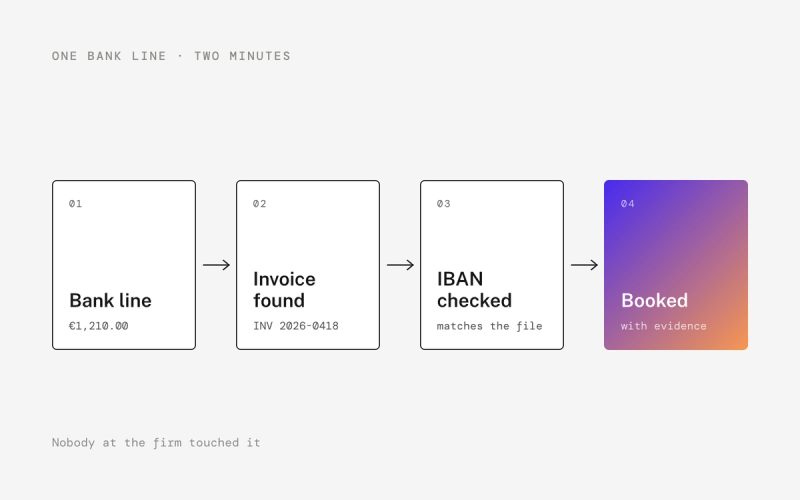
Everything that turns raw events into correct books. Categorising bank lines, matching payments to invoices, booking supplier bills with the right BTW code, splitting payment platform payouts into revenue, fees and refunds, posting recurring accruals and depreciation. The same transaction should be booked the same way every time.
Chasing work
Everything that waits on another person. A missing receipt from an employee. An explanation for a transfer. An approval from a budget owner. A payment from a customer who is three weeks late. It is slow not because it is hard but because the people being chased have other priorities.
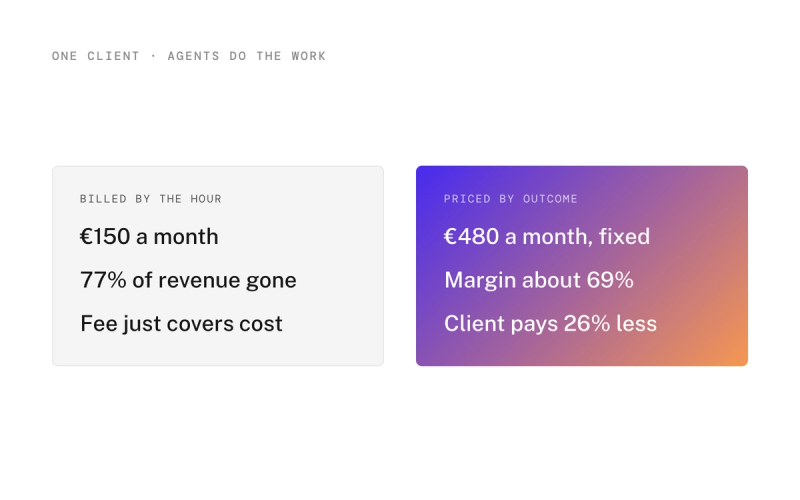
Put numbers on an illustrative month. Say you process 600 bank lines, 150 supplier invoices and 80 sales invoices. At a minute or two per bank line, a few minutes per invoice and some follow-up on the late ones, that is a solid week of one person's month. Most of it ends exactly the way it did the month before.
Which work grows with complexity instead?
The other kind of finance work grows when the business gets more complicated, not just bigger.
- A second entity in another country, with its own VAT registration and intercompany invoices.
- A funding round or a bank facility with reporting covenants.
- A new revenue model, such as annual contracts invoiced up front, that changes how revenue is recognised.
- Pricing decisions that need a margin analysis per customer or product.
- A question from the Belastingdienst that needs a considered answer.
This work is where a good finance hire earns their salary. It is also the work that, in a stretched team, gets done last and in a hurry.
What happens when you hire for the volume?
Say the business doubles its supplier base over the next year. The 150 invoices become 300, the bank lines and reminders follow. If the new person was hired to process volume, they are full again by the following summer, and the same conversation comes back with the next vacancy.
There is a quieter cost too. Good finance people do not stay long in a role that is mostly carrying information between systems. The ones who would be best at the judgement work are the ones most likely to leave.
How do you take the volume off the job first?
Three things have to be in place before transaction and chasing work can run without someone pushing it.
Your rules are written where the work happens
This supplier always goes to that cost centre. Webshop payouts are split into revenue, fees and refunds. Software above a set amount is capitalised. As long as rules like these live in people's heads, every transaction needs a head. Written down once, they can be applied every time.
The chasing starts on an event, not on a person
A card payment arrives without a receipt, so the cardholder is asked that day. An invoice passes its due date, so the reminder goes out. A bill needs approval, so the budget owner gets it with the contract and the previous invoice attached.
Exceptions land in one place
When something does need a person, it should arrive in one queue with the bank line, the document and the reason it was flagged already attached. A well-prepared exception takes seconds. A badly prepared one takes the same twenty minutes it always did.
How do you stay in control while agents do it?
Finance leads are accountable for the numbers, so the hesitation is reasonable. The answer is to extend freedom one task at a time.
- Start every recurring task in ask-first mode. The agent prepares the work and nothing is written without approval.
- Review the proposals for a few cycles and correct the rules where they are wrong.
- When a task's proposals consistently need no changes, switch that task to autonomous, with limits on amounts and new counterparties.
- Leave the rest on ask first for as long as you like. Collections may stay there a long time, because the tone with customers matters.
Two conditions make this safe. Every action has to be traceable to its evidence and to whoever approved it. And every entry has to be reviewable and reversible.
What should the vacancy say instead?
Once the volume is handled, rewrite the job description around what is left. For the company above, it might read like this.
- Review and clear the daily exceptions queue, and improve the rules behind it.
- Own the month-end close review and the VAT return review with the accountant.
- Build and maintain the cash forecast.
- Analyse margin by customer and product, and bring findings to management.
- Prepare the finance side of the second entity.
That is a different person, often a more senior one, and an easier role to fill because it is a more interesting job.
If you run an accounting firm, the same exercise works across your client portfolio. Highlight the client work that grows with each client's transactions. If that work is handled for you, your team reviews instead of keying in, and the next client does not automatically mean the next hire.
Where does Thred fit?
Thred's agents take on the recurring work, such as reconciliation, invoice approvals, accruals, collections and missing documents, on top of the accounting software you already use, or in Thred's own general ledger if you prefer to start fresh. You set the rules, you decide per agent whether it asks first or runs on its own, and every entry traces back to its source. Firms get the same agents across every client administration on the firms side.
If you are drafting your next finance vacancy, book a demo first and see which half of the job description could come off it.
Frequently asked questions
When does a small business need a full-time finance person?
Usually when judgement work starts to pile up: a second entity, financing with reporting obligations, or decisions that need real analysis. Transaction volume alone is a weaker reason, because much of that work can be automated with clear rules.
How do I write a job description for a finance role?
Start from the decisions you need the person to own, such as the close review, the forecast and margin analysis. Then check the draft for tasks that are only about moving, matching or chasing information. If those dominate, decide first whether they should be automated.
Which finance tasks can be automated?
Recurring, rule-based tasks are the best candidates: categorising bank lines, matching payments to invoices, booking supplier bills, sending payment reminders and requesting missing receipts. Decisions on revenue recognition, materiality and tax positions should stay with a person.
How do you keep control over automated bookkeeping?
Start every task in a mode where software proposes and a person approves. Move a task to autonomous only once its proposals consistently need no changes, set limits on amounts and new counterparties, and make sure every entry is traceable and reversible.
Which records does a Dutch business have to keep when bookkeeping is automated?
The same as without automation. The Belastingdienst generally requires business records to be kept for seven years, and some, such as records related to real estate, for longer. Check with your accountant for your situation.