Pricing accounting work by the outcome, not the hour
When agents do the bookkeeping, billing by the hour punishes the firm for every hour it saves. Here is how to price finance work by outcomes instead, with a worked example.

Mark Holleman7 min read

Working on this yourself? Talk to Mark, our co-founder. We’re here to solve it with you.
On this page
Outcome-based pricing in accounting means the client pays a fixed price for defined results, such as books current within two working days, the month closed by working day five and the VAT return filed on time, instead of paying for the hours it took. It only works when those results are measurable, and when software rather than people does most of the production.
I think every accounting firm that adopts agents seriously will have to make this switch, and most will put it off for too long. This piece explains why, what you can actually price, and how the numbers work for one ordinary client. It is written for firm partners first, and for the CFOs and founders on the other side of the engagement letter.
Why does the billable hour break when agents do the work?
The hour was a reasonable proxy for value when value came from people's time. A client with twice as many transactions needed roughly twice as many bookkeeping hours, and the invoice followed.
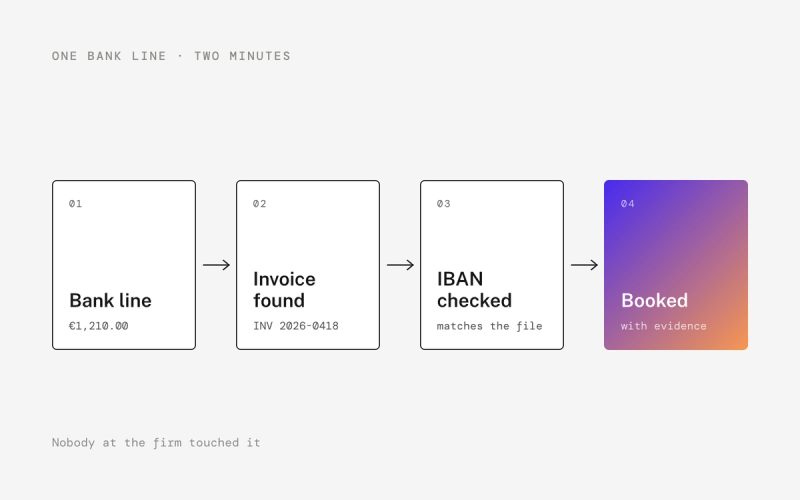
Agents cut that link. When a bank line is matched, booked and documented in minutes without anyone touching it, the hours on the timesheet fall sharply while the work delivered stays the same, or gets better because it happens every day instead of once a month.
Bill only the remaining hours and the client gets all of the saving. Keep billing the old hours and you are charging for work that did not happen, which clients will notice, and some already ask about. Most firms land in between, on a fixed monthly fee that nobody quite defines. That hides the problem for a while, but it gives the client no reason to trust the fee and the firm no way to prove what it delivers.
There is a better thing to price. Clients never wanted hours. They wanted books they can rely on, a VAT return that is right and on time, and a close they do not have to chase. Those are things you can name, measure and price.
Which finance outcomes can a firm actually price?
An outcome only works as a price if three things are true. You can see whether it happened. The firm controls most of what makes it happen. And the client genuinely cares about it.
Here are the outcomes that suit small and mid-sized businesses in the Netherlands and the UK.
- Books are current within an agreed number of working days. Every bank line, sales invoice and supplier bill processed within, say, two working days of arriving. Measurable from the timestamp on each entry.
- Bank accounts are reconciled daily. Ledger and bank agree at the end of each working day, with open differences explained.
- The month is closed by a fixed working day. Accruals, depreciation and deferrals booked, balance sheet accounts reconciled and a short management pack delivered by working day five, for example.
- The VAT return is filed on time and accepted. In the Netherlands, filed with the Belastingdienst by the deadline. In the UK, submitted through Making Tax Digital compatible software. The figures reconcile to the ledger.
- Annual accounts are ready for filing. Prepared from the closed year and filed with the chamber of commerce or Companies House before the deadline.
- Payables and receivables are kept current. Supplier bills ready for the payment run before due date, and reminders on overdue invoices sent on schedule.
Notice what is not on the list. "Strategic advice" and "a better relationship" are real, but you cannot see them on a given day, so they stay priced the way they are today, by time or by project. "Suppliers paid on time" is missing too, for a different reason. The client approves and releases the payments, so the firm does not control the result, even if its agents prepare the run.
What does an outcome price look like for one client?
Take an illustrative client, a 20-person wholesaler in Utrecht with around 350 bank lines a month, quarterly VAT and an Exact Online administration. The numbers below are made up, but they add up, and the shape is typical.
Here is the hourly model without agents. Eight hours of bookkeeping a month at €70 is €560. The quarterly VAT return takes three hours at €90, which is €270 a quarter, or €90 a month. The client pays €650 a month. If the firm's cost for a person's hour is €45, nine hours cost €405, and the firm keeps €245, a margin of about 38%.
Here is the hourly model with agents. Agents now do the production. A person reviews exceptions for 1.5 hours a month and reviews the VAT return for 1.5 hours a quarter. Billed by the hour, the client pays €105 plus €45, so €150 a month. The firm has done better work and lost 77% of its revenue on this client. Add the €60 a month it now pays for software and agents, and the fee covers the firm's cost and nothing more.
Here is the outcome model with agents. The firm charges a fixed €480 a month for five defined outcomes, which are books current within two working days, daily bank reconciliation, the month closed by working day five, the quarterly VAT return filed on time and a monthly management pack. People spend two hours a month on review, costing €90, and software and agents cost the same €60. Delivery costs €150, and the firm keeps €330, a margin of about 69%.
Look at who wins. The client pays €170 a month less than before, about 26% lower, and gets books that are current every day instead of once a month. The firm earns €85 more per client per month than in the old hourly model, and frees seven hours of a qualified person's time per client per month. Across a hundred clients like this, that is the difference between hiring and not hiring.
How do you write an outcome into an engagement letter?
The outcome has to be specific enough that both sides would agree, on any given day, whether it was met. A few clauses do most of the work.
Define each outcome with a measure. "Books current" means no unprocessed bank line, sales invoice or supplier bill older than two working days, excluding items waiting on the client. Write the measure, not the intention.
Stop the clock when the client owes you something. The single biggest cause of late books is a missing document or an unanswered question. If the receipt for a €2,400 card payment has not arrived, the outcome is paused for that item, and the client can see why. Agents that request documents and follow up automatically make this fair, because the request is timestamped and visible.
Price by complexity band, not by transaction count alone. Group clients by what makes the work harder, such as number of bank accounts, payment platforms, foreign currencies, cross-border VAT and entities. A Shopify store with Stripe and PayPal payouts is a different band from a consultancy with twenty invoices a month.
Add a service credit. If an outcome is missed for reasons the firm controls, the client gets, for example, 10% of that month's fee back. On €480 that is €48. It is small enough not to frighten the firm and large enough to show you mean it.
Price the clean-up separately. Taking on a client with eighteen months of unreconciled history is a project. Quote it as one, then start the outcome price from a clean opening balance.
What should a CFO or founder ask for?
If you buy finance services, outcome pricing is in your interest, but only if you can check it. Ask the firm four questions.
- How will I see, on any day, whether each outcome is being met?
- What share of the work do your agents finish without a person, and how often does a person later correct it?
- What happens to my fee when you miss an outcome?
- Which items are paused because they are waiting on me, and who is chasing them?
A firm that can answer these from a live view of your books has the systems to run outcome pricing. A firm that answers with a timesheet does not yet.
What can go wrong with outcome pricing?
A few traps catch firms that switch too quickly.
Some firms price before the agents are doing the work. If people still do most of the production, a fixed outcome price just moves the overrun risk to the firm. Measure how much work agents finish end to end for a few months first.
Volume can spike. A client that doubles in size will strain a fixed fee. Review bands twice a year, and write that review into the letter.
Nobody checks the outcomes. If the firm does not measure its own delivery, outcome pricing slowly turns back into an undefined fixed fee. The measure has to come from the system, not from someone's memory at year-end.
Some firms put advice on an outcome price. Tax advice, a restructuring, a due diligence request or a difficult conversation with the Belastingdienst depend on judgement and on a scope that changes from case to case, so they belong on time or project pricing. Keep outcome prices for the recurring, measurable core.
Why does this matter now?
Pricing tends to lag behind delivery. A 2026 study of 182 business services leaders by the pricing consultancy Simon-Kucher found that time-and-material billing is not significantly declining, even as firms invest in AI. That gap is an opportunity for the firms that move first. Clients we work with are starting to ask why fees have not changed when the work clearly has, and the firms with a clear outcome price will have a better answer than a discount.
At Thred, every task an agent does is recorded with its source, its timing and whether a person changed it. That trail is what makes an outcome provable rather than promised. Our Accounting Firms product gives a firm that view across all its clients, on top of the ledgers they already use through Layer. For finance teams buying the work, the same view is part of what we offer businesses.
If you want to work out an outcome price for your own client base, book a demo and bring a few real clients.
Frequently asked questions
Is outcome-based pricing the same as a fixed fee?
Not quite. A fixed fee sets the price but often leaves the deliverables vague. Outcome-based pricing fixes the price and defines each result with a measure both sides can check, usually with a service credit when the firm misses one for reasons it controls.
Which accounting services suit outcome pricing?
Recurring work with a clear, observable result, such as bookkeeping kept current, daily bank reconciliation, a monthly close by a set working day, VAT returns and annual accounts filed on time. Tax advice, restructuring and other judgement-heavy work usually stays on time or project pricing.
What happens when the client causes the delay?
A good engagement letter pauses the outcome for items that are waiting on the client, such as a missing receipt or an unanswered question. Requests should be timestamped and visible to both sides so it is clear who is waiting on whom.
How should a firm set outcome prices?
Group clients into complexity bands based on what makes the work harder, such as the number of bank accounts, payment platforms, currencies, entities and cross-border VAT. Price each band on the firm's actual delivery cost with agents doing the production, and review bands at least twice a year.
Does outcome pricing mean clients pay less?
Often a little less than under hourly billing, while getting faster and more current books. The firm can still earn more per client because agents carry most of the production work. The balance depends on how much of the work is genuinely automated.
Sources
Read next
- Where does the answer live? Splitting firm work between agents and accountants
- Will AI replace accountants? An honest answer for accounting firm owners
- Accounting firm AI adoption statistics 2026: sourced figures for the UK, the Netherlands and beyond
Where Thred comes in
Make your firm more efficient with AI, so you have more time for relationships, new customers and advisory work.