Why accounting is the first professional service agents will rebuild
Accounting work carries its own answer key. Debits equal credits, the bank agrees or it does not, the VAT return ties to the ledger. That is why agents will rebuild it first.

Mark Holleman7 min read

Working on this yourself? Talk to Mark, our co-founder. We’re here to solve it with you.
On this page
Accounting will be the first professional service that agents rebuild because its work checks itself. Every entry must balance, every bank account must agree with the bank, and every VAT return must tie to the ledger. When software can tell, without a person, whether its own work is right, it can be trusted to do most of that work.
I want to make the case properly, because it matters for how finance teams and accounting firms plan the next few years. The usual argument is that accounting is repetitive and rules-based. That is true, but plenty of work is repetitive. The real reason is that accounting comes with an answer key.
What makes accounting different from other professional work?
Think about the output of most professional services. A negotiated contract, a strategy memo, a marketing plan. You can judge whether they are good, but only with time, experience and often hindsight. There is no number that tells you, the moment the work is done, that it is correct.
Accounting has those numbers everywhere. Double entry means every booking has to balance, so a whole class of mistakes cannot exist in a finished ledger. The bank statement is an independent record kept by someone else, so the cash accounts are either right to the cent or they are not. Supplier and customer balances have to add up to their control accounts. The VAT return has to agree with the VAT accounts. The balance sheet has to carry forward from one year to the next.
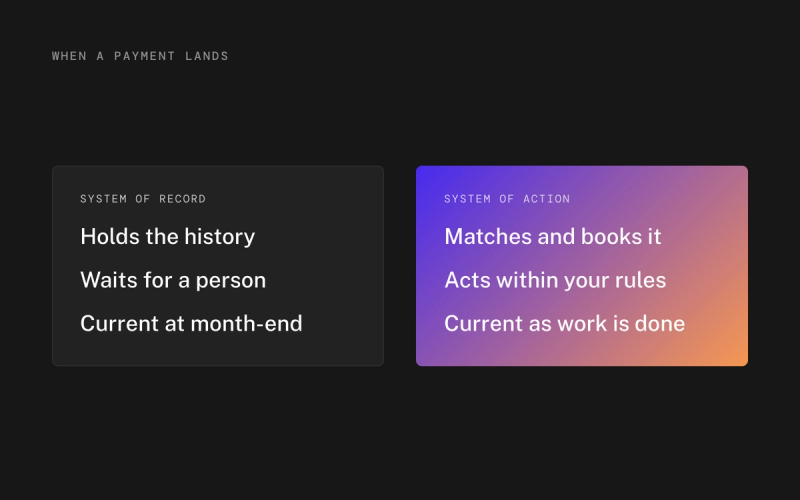
None of this was designed for software. It was designed so that people could catch each other's mistakes. But it means an agent can catch its own. When the Bookkeeper agent books a payment and the bank reconciliation still shows a €0.00 difference, that is not a confidence score. It is proof that this part of the work is right.
What are the five properties that make accounting ready for agents?
Being checkable is the most important, but four other properties help. Together they explain why finance gets there before most other professional work.
1. The work checks itself. As above. Balances, reconciliations and ties between ledgers give an objective test after almost every step.
2. The inputs already arrive as data. Bank lines come in through bank feeds, which in the EU are backed by PSD2 rules on access to account data with the customer's consent, and in the UK by open banking. Stripe, Mollie and PayPal provide payout and settlement reports that itemise every fee and refund. More supplier invoices arrive as structured e-invoices, and the EU's VAT in the Digital Age package will introduce digital reporting, built on e-invoices, for business-to-business trade between member states from July 2030. Compare that with professions where the main input is a conversation.
3. The rules are written down. VAT law, reporting standards such as IFRS, Dutch GAAP or UK FRS 102, and a company's own chart of accounts and policies. They are not always simple, but they are written, and an agent can apply written rules consistently. The client-specific rules, such as how a holding company recharges costs or which software subscriptions are prepaid for the year, can be written down too. In Thred they live as memories that every agent reads before it works.
4. It repeats on a calendar. Bank lines every day, supplier bills every week, a close every month, VAT every quarter, accounts every year. Repetition gives an agent the history to learn from, and the calendar gives frequent moments where the work is checked again.
5. Mistakes are visible and reversible. A wrong booking is not a wrong diagnosis. It shows up in a reconciliation or a review, and it is corrected with a reversing entry while the original stays in the record. A well-run ledger never deletes anything, so every correction is itself traceable.
Most professional work has one or two of these properties. Bookkeeping and the routine parts of accounting have all five.
Why hasn't this happened already?
Accounting software has been automating parts of the work for decades, so it is fair to ask what is different now.
Earlier automation followed fixed rules. If the description contains this word, book it to that account. Those rules break the moment something changes, and a person has to step in, so they handle the easy, predictable cases and leave everything else in a queue.
Agents can do what the rules could not. They read a supplier invoice they have never seen before, compare it with the contract, look up how a similar bill was booked last year, ask the client one precise question when something is unclear and book the answer. The checks are what make that safe. An agent that reads and reasons is only useful in finance because the ledger tells it, and you, when it is wrong.
What stays with people?
The answer key covers a lot, but not everything. Some of the most important accounting work has no independent check, and it should stay with qualified people.
- Estimates need an owner. Bad debt provisions, warranty provisions, the useful life of an asset, whether stock is worth what it cost. Agents can prepare the analysis. A person should own the number.
- Revenue on complex contracts needs judgement. When to recognise revenue on a complex contract with several deliverables is a matter of reading the contract against the standard, and reasonable people can disagree.
- Tax positions belong to the adviser. Whether a cost is deductible, how to structure a group, how to respond to a question from the Belastingdienst or HMRC. Agents can gather the facts, but the position is the adviser's.
- Sign-off carries a name. Annual accounts are signed by the directors, and the VAT return and anything else filed with an authority carry a person's or firm's name. That accountability does not transfer to software, and it should not.
- The client conversation stays human. Explaining what the numbers mean for a hiring plan or a funding round is where accountants add the most value, and it is the part they have the least time for today.
The shift is not that people disappear from accounting. It is that the routine bookkeeping underneath them, the part with the answer key, moves to agents.
In what order will agents take over a finance function?
If checkability is the reason, it also predicts the sequence. Work with the clearest check goes first.
- Bank reconciliation and cash go first. The bank statement is the check. This is where agents usually start, and where the share of work finished without a person rises fastest.
- Payables come next. Bills are checked against purchase orders, contracts and the supplier's history, and the payment run is checked against the bank.
- Receivables follow. Open customer items have to tie to the receivables control account, and every receipt has to match an invoice or be explained.
- The month-end close is fourth. Accruals, deferrals and depreciation follow written policies, and the trial balance has to balance before anything is reported.
- VAT comes fifth. The return is prepared from a reconciled ledger and has to tie to the VAT accounts. A person reviews it before filing.
- Year-end comes last. Most of the preparation can be done by agents, but the estimates stay with an accountant and the directors sign.
This is the order we usually recommend to the businesses and firms we work with. It is also a useful planning tool. If you are a finance lead, you can ask of any process, "what is the check?" If there is a clear one, it is a candidate for agents now. If there is not, keep it with people for longer, or create a check first.
What does this mean for finance teams and accounting firms?
For a CFO or controller, it changes how you evaluate software. Do not ask whether an agent is clever. Ask what check it runs after each step, what happens when the check fails, and whether you can see the evidence. An agent that cannot show you a reconciliation is asking you to trust it rather than to verify it.
For an accounting firm, it changes what the firm is good at. Your review procedures, the checks your best senior accountant runs before signing anything, become the most valuable thing you own. Write them down and give them to agents, and they are applied to every client every day instead of to some clients at year-end. That is how a firm serves more clients with the same team, which is what our Accounting Firms product is built for.
It also changes what a ledger should be. A ledger built for people typing in entries before a deadline only runs its checks when someone opens it. A ledger built for agents runs them as each transaction is booked. That is why we built our own agentic general ledger, Thred Ledger, with every entry traceable to its source, and why our Layer runs the same checks on top of Exact Online, Xero, Twinfield or Moneybird for businesses that keep their current software.
Accounting was designed centuries ago so that people could prove their work to each other. It turns out that is exactly what agents need. If you want to see those checks running on your own books, book a demo.
Frequently asked questions
Will AI agents replace accountants?
They will replace much of the production work, such as matching, booking and reconciling, but not the accountant. Estimates, judgement on revenue, tax positions, sign-off of filings and client advice remain with qualified people, who spend more of their time on them.
Which accounting tasks are easiest to automate with agents?
Tasks with an independent check come first. Bank reconciliation is checked against the bank statement, supplier invoices against orders and payments, and receivables against the control account. Work without a clear check, such as provisions, should stay with people longer.
Why did earlier accounting automation not go further?
Earlier automation relied on fixed rules, such as booking a description keyword to an account. Those rules break when anything changes, so a person handled every exception. Agents can read new documents, compare them with contracts and history and ask a precise question, while the ledger's checks show whether the result is right.
How does EU e-invoicing affect automation in accounting?
Structured e-invoices give agents clean data instead of scanned documents. Under the EU's VAT in the Digital Age package, digital reporting based on e-invoicing starts for cross-border business-to-business supplies from July 2030. Check your own obligations with your accountant.
How should a finance lead evaluate an accounting agent?
Ask which check the agent runs after each step, what happens when the check fails and whether you can see the evidence behind each entry. An agent that cannot show a reconciliation or the source of a booking asks for trust instead of offering verification.
Sources
Read next
- How an accounting service runs when agents do the work
- Real-time books: what changes when your ledger is always current
- Handing journal entries to an agent: a four-week plan for controllers
Where Thred comes in
Thred’s own general ledger, built for agents. Every transaction is booked as it happens, under your rules, and traceable back to its source.