Start your SME finance dashboard with free cash
The bank balance is the number founders watch most and trust least. Build your finance dashboard around free cash instead, and let every other number explain it.

Mark Holleman5 min read

Working on this yourself? Talk to Mark, our co-founder. We’re here to solve it with you.
On this page
A useful SME finance dashboard is built around free cash: the money in the bank that is not already owed to the tax authority, your staff or your suppliers. Every other number on the page should explain why free cash will go up or down.
If you run a company of twenty to a hundred people, there is a good chance the first thing you check in the morning is the bank app. It is quick, it is live and it feels like the truth. It is also the number most likely to make you say yes to something you cannot afford.
This post is for founders and finance leads who want one page they actually use. We start with a single calculation, then build outwards from it.
Why is the bank balance the wrong headline?
Because a large part of it already belongs to someone else.
Take an illustrative business. The accounts show €184,200 this morning. Inside that figure sit three things you have no real choice about.
- VAT you collected for the Belastingdienst. The Q2 return is due at the end of July, and €41,350 of the balance is that payment.
- Wages and wage tax. Payroll runs on the 25th and costs €32,800.
- Bills you have already approved. €13,750 is due to suppliers in the next fourteen days.
Subtract them and €96,300 is left. That is the money you can genuinely decide about, and it is about half of what the bank app shows.
Nothing about this is exotic. It is simply the difference between cash you hold and cash you own. But once you see it written down, it changes how you read every other figure.
How do you calculate free cash?
Keep the formula short enough that anyone in the company can repeat it.
- Start with the balance on all operating accounts today.
- Subtract the VAT payable on your next return, based on the VAT already booked this period.
- Subtract the next payroll run, including wage tax and pension contributions.
- Subtract supplier bills that are approved and due within a window you choose, two weeks works for most businesses.
- Subtract anything else already committed with a date on it, such as a loan repayment or a corporate income tax instalment.
What you leave out matters as much. Do not add money customers owe you, however certain it looks. Do not count an unused credit line as cash. Both belong next to free cash as separate lines, so you can see them without mistaking them for money you have.
How does free cash become runway?
Divide free cash by your average net burn, meaning cash out minus cash in, over the last three months. In the example, that business burns €6,880 a month on average. €96,300 divided by €6,880 is 14.0 months.
That single figure answers more questions than any profit chart. It also makes the next commitment easy to test. Say you are about to hire someone at €4,500 a month including employer costs. The burn becomes €11,380, and €96,300 divided by €11,380 is 8.5 months.
If your own rule says no new fixed costs below nine months of runway, you now know what has to happen first. Collecting the €18,400 that is overdue would lift free cash to €114,700, which at €11,380 a month gives 10.1 months. The hire is still possible. It just has an order of operations.
Which numbers explain where free cash is heading?
Free cash is a snapshot. To know where it goes next, you need the few things that move it. For most small businesses there are only a handful.
- What customers owe you, and how late they are. Not as a total, but as names with amounts, oldest first. This is the cash you can pull forward with a phone call.
- What leaves in the coming weeks. The next VAT payment and its date, payroll, and the bills already approved.
- The burn rate itself. If it creeps up for three months in a row, runway shrinks even when the balance looks fine.
- Margin on what you sell. A product line that slowly loses margin eats free cash long before it shows up as a loss.
Each of these is there because it changes the free-cash figure. If a number you are tempted to add does not, it probably belongs in the month-end report rather than on this page.
Where should you draw the lines?
Agree in advance where a number triggers a decision, and write that line next to it in plain words. These are examples. Set your own.
- Runway below nine months means no new fixed costs until it recovers.
- A customer more than thirty days overdue gets a call from a person, not another automated email.
- Free cash above a buffer you set, say €85,000, gets moved to a savings or deposit account.
- Margin on a product line that falls two months running gets a price or supplier review.
The value of writing the line down is that the debate happens once, calmly, instead of every time the number moves.
Why is free cash a test of your bookkeeping?
Look at what the calculation needs. The VAT figure is only right if every sale and purchase this quarter carries the correct VAT code. The approved bills are only known if supplier invoices are in the ledger, not in someone's inbox. The overdue list is only true if incoming payments have been matched to the invoices they settle.
So when free cash looks strange, it is often not the business that is strange. It is the books behind it. A VAT figure that jumps after your accountant's quarterly review, a customer who appears overdue but paid last week, a supplier bill that surfaces three days before it is due: each one is a bookkeeping gap showing up as a wrong cash number.
That makes free cash a useful health check. If you cannot work it out in five minutes on any given morning, the problem to solve is not the dashboard.
How do you use it without another weekly meeting?
A page you have to remember to open tends to stop being opened. Turn it round so the page comes to you at the moments that matter.
- Before any commitment over an amount you set, a hire, a lease, a large order, check the runway with the new cost included.
- When a line is crossed, someone gets told the same day, with the reason.
- Once a month, look back at the lines themselves and ask whether they are still the right ones.
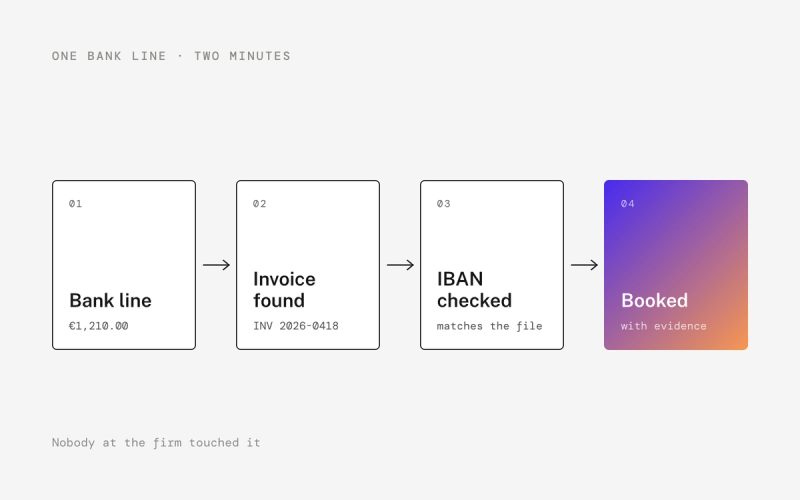
This is the part where agents help most. At Thred, agents keep the books current as transactions arrive, either in Thred's own ledger or on top of the accounting software you already use, so the inputs to free cash are not weeks old. The Treasurer watches cash and runway and tells you when free cash crosses the buffer you set. The Collector follows up the overdue invoices that would pull it back up. You can also ask for a dashboard in chat and build it from live numbers instead of an export.
If finance is on your plate and you want one number you can trust every morning, see how Thred works for businesses, or book a demo and see free cash on your own books.
Frequently asked questions
What is free cash in a small business?
Free cash is the part of your bank balance that is not already owed to someone. You take the balance and subtract VAT payable on the next return, the next payroll including wage tax, and supplier bills that are approved and due soon. What remains is the money you can actually decide about.
Should VAT I have collected count as my cash?
It sits in your account, but it is owed to the tax authority on your next return. Treating it as spendable is one of the most common reasons small businesses are caught short at quarter end. Reserve it in your calculations, or move it to a separate account as you collect it.
How do you calculate cash runway for an SME?
Divide free cash by your average net monthly burn, which is cash going out minus cash coming in, usually averaged over the last three months. Recalculate it whenever you are about to take on a new fixed cost, because a single hire or lease can change it a lot.
How much runway should a small business keep?
There is no single right number. It depends on how predictable your income is, how quickly you could cut costs and whether you have access to credit. The useful step is to agree your own minimum in advance and write down what you will do when runway drops below it.
Why does my finance dashboard not match my bank app?
Usually because the books behind the dashboard are behind. Payments that have not been matched to invoices, supplier bills still in an inbox or VAT codes corrected later all make the dashboard drift from reality. Keeping bookkeeping current is what makes the two agree.