From system of record to system of action
Finance software has always been good at keeping the history. The next step is software that moves the work forward. What a system of action is, what it needs, and how to judge one.

Manoj Tutika7 min read

Working on this yourself? Talk to Mark, our co-founder. We’re here to solve it with you.
On this page
Your general ledger is a system of record: it holds the history of a business in balanced, checkable form. A system of action uses that record to do the next piece of work, such as matching a payment, chasing an invoice or asking for an approval, within rules people set.
Every finance team already owns a very good memory. The general ledger knows every invoice, every payment and every journal line, often going back a decade. Ask it about any month and it will answer to the cent.
Ask it what should happen next, and it has nothing to say.
That gap is the subject of this post. For most of the history of accounting software, the ledger was a system of record. It held the books and waited for people to bring them up to date. The work that moved the business forward, such as chasing a customer, approving a bill or fixing a misbooked payment, happened somewhere else. We think the next generation of finance software closes that gap and becomes a system of action, software that does not just hold the record but acts on it.
Why was the system of record never the bottleneck?
It is worth being fair to the system of record. Double-entry bookkeeping is one of the most durable inventions in business, and modern ledgers are excellent at it. They enforce balance, keep an audit trail, produce statements and meet local reporting rules. Nobody in finance wants to give that up.
The problem sits around the ledger, not in it. If you are the founder of a company with a few dozen people, or the one finance lead keeping it running, your Monday probably looks something like this.
- A customer is 30 days overdue. Someone notices in an ageing report, writes an email, sets a reminder to check again.
- A bank line does not match any open invoice. Someone puts it in a spreadsheet called "to investigate".
- A supplier invoice needs approval. Someone forwards it to a manager and waits.
- A subscription renewed at a higher price. Nobody notices until the quarterly review.
In every case the ledger holds the facts. In every case a person has to see the fact, decide what it means and do something about it. The ledger is the memory. People are the hands, and their inboxes, spreadsheets and calendars are the real workflow engine of finance.
That worked when there was no alternative. It also explains why books are often only current at month-end or quarter-end. The record is only as fresh as the last time a person had time to act on it.
How is a system of action different from a system of record?
A system of action starts from a different question. Instead of "what is in the books?", it asks "what needs to happen now, and can I do it?".
In our earlier piece on the agentic general ledger, we described agents that ingest, post, reconcile and explain. That is the engine. A system of action is the broader idea of who moves the work. In practice, three things change.
First, the default flips from waiting to acting. When a payment lands, the system does not just store the bank line. It looks for the invoice, matches it, books it, and closes the receivable. When a customer goes overdue, it sends the reminder at the time you agreed.
Second, people move from doing to deciding. You stop being the hands that keep the record current and become the one who sets the rules and handles what falls outside them. For a founder, that means finance stops eating your evenings. For a finance lead, it means capacity without another hire.
Third, the record becomes a by-product. When every action is booked as it happens, the ledger is current because the work is done, not because someone sat down to update it.
What does a system of action need to be trusted?
Software that acts on your books is only useful if you can trust it. Acting is easy. Acting correctly, within limits, and explaining itself afterwards is the hard part. In our experience building this, five things matter.
A record that is actually current
You cannot act sensibly on stale data. An agent that sends a payment reminder to a customer who paid yesterday does more damage than no agent at all. A system of action needs bank feeds, payment platforms, inboxes and the ledger connected and synced continuously, so the facts it acts on are today's facts.
Regulation is moving in the same direction. Under the EU's VAT in the Digital Age package, e-invoicing and near real-time digital reporting become the default for cross-border B2B trade from 2030. Books that are only current once a quarter will fit that world poorly.
Your rules, written down
Every business has policies that live in people's heads. Which suppliers can be paid without a manager, how to treat a founder's card expenses, when to stop sending reminders and pick up the phone. A system of action needs those rules stored where the agents can apply them, and needs to learn new ones as they come up.
Permissions you set per task
Not every task deserves the same freedom. Reading data is low risk. Booking a recurring subscription is moderate. Paying a new supplier is high. A good system lets you decide, task by task, whether an agent asks first or acts within limits. Trust should be granted in steps, not all at once.
A trail for every action
If a system books something, you should be able to open the entry and see why. Which document, which bank line, which rule, which agent or person, and who approved it. This is not a nice extra. It is what lets your accountant, your auditor and your own team rely on the numbers, and in the Netherlands the Belastingdienst expects the underlying records to be kept for seven years. It is also why agents should read by default and write only with your permission.
A clear place for exceptions
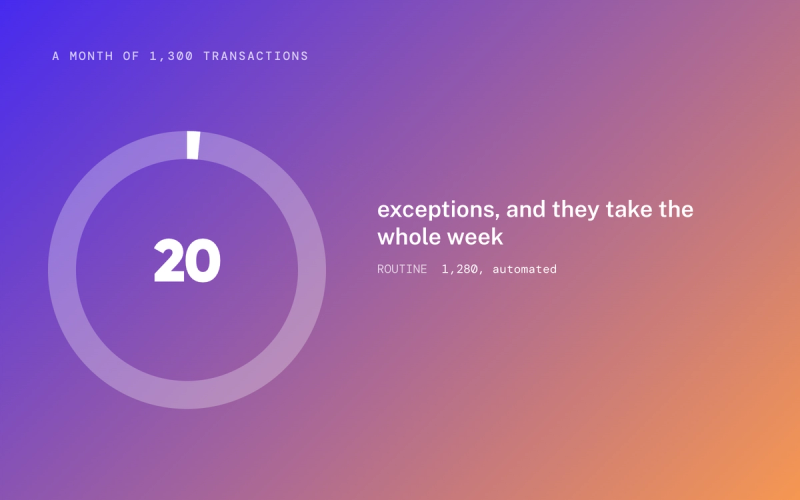
The goal is not zero human involvement. It is that people only see what genuinely needs them, in one place, with the context to decide quickly. A missing receipt, an unusual payment, an approval above your limit. If exceptions are scattered across email threads, you have rebuilt the old workflow with extra steps.
How do you move from one to the other?
There are two realistic paths, and which one fits depends on where you are.
The first is to keep your current ledger and add a system of action on top of it. Your accounting software stays the system of record for your accountant and your filings, and agents do the work alongside it. This is what Thred Layer does. It keeps a copy of the ledger in sync, does the work there and writes the finished entries back. Nothing has to be migrated, which matters when an accountant, a year of history and a VAT routine are built around the existing tool.
The second is a ledger where record and action are the same system. Thred Ledger is our own general ledger, built for agents to work in rather than for people to type into. Transactions are booked as they happen, and VAT returns and annual accounts are prepared from books that are already correct. For a business starting fresh, or one that has outgrown its current setup, it removes the sync between two systems entirely.
Both paths share the same principle. Double-entry discipline, the audit trail and the statutory output are not up for negotiation. What changes is that something other than a person's to-do list is responsible for keeping it moving.
What should you ask before adopting one?
Whichever product you look at, these questions separate real systems of action from dashboards with a chat window.
- What does it do when nobody is logged in? If the answer is "nothing until you open it", it is still a system of record.
- Can it explain every action it took, down to the source document?
- What can it not do without asking, and who decides that?
- Where do exceptions go, and how much context comes with them?
- When it gets something wrong, how is it corrected, and does it learn from the correction?
Does the system of record still matter?
None of this makes the ledger less important. If anything, it makes it more important, because a system of action is only as good as the record it acts on. The difference is that the record no longer depends on people finding time to maintain it.
That is the shift we are building Thred around, for businesses and accounting firms alike. Finance teams and accountants keep the judgement. The agents keep the books, and keep them moving.
If you want that on the accounting software you already use, start with Thred Layer. If you are ready for a ledger built for it, look at Thred Ledger. Either way, book a demo and we will show it on your own books.
Frequently asked questions
Is an ERP a system of record or a system of action?
Most ERPs and accounting packages are systems of record. They keep a reliable history of transactions and enforce accounting rules, but people still decide and carry out the next step. Workflow features help, yet the work itself is usually still done by a person.
Does a system of action replace the general ledger?
No. It depends on an accurate ledger, because every action it takes is based on the record. It can run on top of an existing ledger or be built into a ledger designed for agents.
How do you keep control when software acts on your books?
Grant permissions per task, starting with read access and asking first for anything that writes. Require a trail for every action, back to the source document and the rule applied, and route anything outside your limits to a person.
Which finance tasks suit a system of action first?
Repetitive, rule-based work with a clear outcome is the best start, such as bank reconciliation, payment reminders and preparing supplier invoice approvals. Tasks that need judgement, like classifying an unusual transaction, stay with people as exceptions.
Do accountants still need to review the books?
Yes. A system of action keeps the books current, but filings and year-end accounts still need professional review. The difference is that the accountant reviews and decides instead of keying in and chasing.
Sources
Read next
- Deferred revenue for SaaS annual plans: how to book it and release it monthly
- Spreadsheets and AI: what a finance lead can do in Excel today, and when the spreadsheet is the problem
- Holding BV and operating BV: intercompany bookkeeping basics
Where Thred comes in
Thred’s own general ledger, built for agents. Every transaction is booked as it happens, under your rules, and traceable back to its source.