What auditors look for in journal entry testing, and how to be ready
Every statutory audit includes testing of your journal entries. What the auditor selects, what they ask for, and how to have the answer ready before they ask.
David van Duijn6 min read

Working on this yourself? Talk to Mark, our co-founder. We’re here to solve it with you.
On this page
Journal entry testing is the part of a financial statement audit where the auditor selects entries from your general ledger, usually manual or unusual ones, and checks that each is genuine, authorised and supported by evidence. Auditing standards require it in every audit, because journal entries are where management can override controls and misstate the numbers.
If you are the controller or CFO of a company that has its annual accounts audited, this is one of the most predictable requests you will get. And yet many finance teams spend days in audit season digging up approvals and documents for entries made months earlier. It does not have to work that way.
Who needs to deal with journal entry testing?
Any company with a statutory audit, and any company that chooses one for its investors or bank.
In the Netherlands, medium-sized and large BVs and NVs must have their annual accounts audited by an external accountant, a registeraccountant (RA) or accountant-administratieconsulent (AA) working at an audit firm licensed by the AFM. A company counts as small, and is exempt, when for two consecutive years it stays below at least two of three limits. For financial years starting on or after 1 January 2024 these are €7.5 million in total assets, €15 million in net turnover and 50 employees on average.
In the UK, a private company can usually claim audit exemption if it meets at least two of three conditions. For financial years beginning on or after 6 April 2025 these are a turnover of no more than £15 million, assets of no more than £7.5 million and 50 or fewer employees on average. Groups, regulated companies and some others follow different rules.
Thresholds change and exceptions apply, so check your position with your accountant.
Why do auditors test journal entries?
The auditing standard on fraud, ISA 240, which Dutch auditors apply as NV COS 240 and UK auditors as ISA (UK) 240, treats management override of controls as a risk present in every entity. The most direct way to override controls is to post an entry that bypasses the normal process. So the standard requires the auditor to test whether entries in your ledger, and the adjustments made while drawing up the annual accounts, are appropriate.
This means your auditor is not looking for typos. They are looking for entries that move results in a direction someone wanted, without the usual checks.
How does journal entry testing work?
The process has a recognisable shape, even though every audit firm runs it its own way.
1. Understanding your process
The auditor asks how entries get into the ledger. Which entries come from subledgers such as sales invoicing, purchasing and payroll? Which are made by hand? Who can post, who approves, and can anyone post to a closed period? Expect a walkthrough of a few entries from source to ledger.
2. Getting a complete extract
You provide an export of every journal line for the year. The auditor reconciles it to your trial balance, opening balance plus movements equals closing balance for every account. Until those totals agree, the auditor will not begin selecting entries.
3. Selecting entries with risk characteristics
Using data analysis, the auditor filters the extract for entries that look like they could be used to manipulate results. Typical characteristics include:
- Manual entries outside the normal invoice and bank flow
- Entries posted late at night, at weekends or on public holidays
- Entries from user accounts that rarely post, including those of directors or the CFO
- Unusual account combinations, such as costs moved out of the profit and loss onto an intercompany or equity account
- Round amounts or amounts just below an approval limit
- Entries to rarely used or suspense accounts
- Entries made after period end but dated within the period, and reversals early in the next period
- Entries with no description or a vague one
4. Testing the selection
For each selected entry, you are asked for the supporting evidence. What is it for, who made it, who approved it and which document backs it up. The auditor checks that the explanation is plausible and the evidence matches.
A worked example of a selection
Here is an illustrative example for a company with about €20 million in turnover:
- The full extract has 18,240 journal lines for the year
- 17,120 come from subledgers and bank processing, and 1,120 are manual
- Filters for risk characteristics flag 214 of the manual lines
- The auditor selects 36 entries for testing, covering every characteristic and including all entries above their threshold
For each of the 36, the finance team must produce the evidence. If every entry carries a description, a document, the poster and the approver, that takes an afternoon. If the support sits in email threads and memories, it takes a week, and gaps become findings.
What evidence will your auditor ask for?
For each selected entry, expect questions in four areas:
- Purpose. A description that explains the entry in plain words, not "correction" or "per discussion".
- Support. The underlying document, such as a contract, a calculation, a supplier statement or a board decision.
- Authorisation. Who posted the entry, who approved it, and whether the approver was independent of the poster.
- Timing. When it was posted, compared with the period it affects, and whether the period was already closed.
The auditor will also ask for a list of users with posting rights, for evidence that closed periods are locked, and for the log of any reopening.
How do you prepare your ledger for journal entry testing?
The best preparation happens during the year, not in audit season.
Make every entry explain itself
Each journal entry should carry a useful description, a link to its source document and the identity of whoever posted it. For entries generated by software, the record should show which rule or agent produced it and who approved it.
Keep manual entries rare and reviewed
Every manual entry is a candidate for selection. Fewer manual entries means a smaller population to test. The ones you need, such as accrual estimates, provisions and corrections, should have a second-person review recorded on the entry itself.
Lock periods and log reopens
Lock each month after close. If a period must be reopened, record who did it, when and why. Late entries dated in a closed period are a classic risk characteristic, and a log turns a question into a quick answer.
Review access rights regularly
Know who can post to the ledger and remove access when people change roles or leave. Your auditor will compare posting users with the access list.
Run the auditor's filters yourself
Before the audit, filter your own ledger for the characteristics listed above and review what comes out. Agents can do this continuously, flagging weekend postings, round amounts to suspense accounts or entries without a document as they happen, so they are explained in the week they were made.
How does software change journal entry testing?
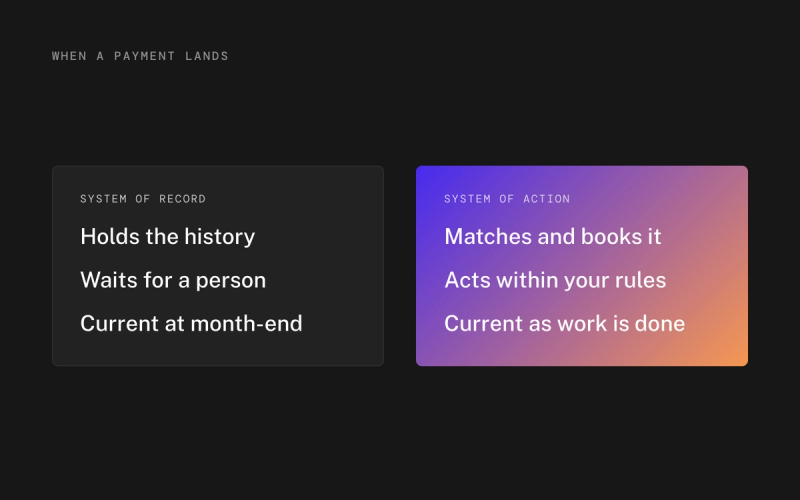
When an agent books a supplier invoice, matches a bank line or prepares a depreciation entry, it can record everything an auditor asks for at the moment of booking. The source document, the rule applied, the time, and the person who approved it. The share of entries made by hand drops, and the remaining manual entries stand out clearly because they are the exception.
It also changes the timing. Instead of reconstructing evidence months later, the evidence exists from the start. A finance team that keeps its ledger this way can hand over a complete, reconciled extract on the first day of fieldwork.
This is how Thred's ledger is built. Every entry is traceable back to its source, with the agent or person who booked it and the approver recorded, so the books are audit-ready at any moment and not just at year-end. If you work in Exact Online or another existing ledger, Thred Layer adds the same traceability on top.
Where does Thred fit?
If your company is crossing the audit threshold, or your current audit always turns into a document hunt, Thred agents keep the books current and every entry documented as it is booked. See how the Thred ledger works, or book a demo and we will show you what an auditor would see.
Frequently asked questions
Which companies need a statutory audit in the Netherlands?
Medium-sized and large BVs and NVs. A company is small, and exempt, if it stays below two of three limits for two consecutive years, which for years from 2024 are €7.5 million assets, €15 million net turnover and 50 employees. Confirm your position with your accountant.
When is a UK company exempt from audit?
For financial years beginning on or after 6 April 2025, a private company usually qualifies if it meets two of three conditions, turnover up to £15 million, assets up to £7.5 million and 50 or fewer employees. Groups and regulated companies have different rules.
What do auditors look for in journal entries?
Entries that bypass normal processes or look unusual, such as manual entries, postings at weekends or by unusual users, round amounts, entries to suspense accounts and entries made after period end but dated inside it.
What evidence do I need for a journal entry?
A clear description of the purpose, the supporting document, who posted it, who approved it and when it was posted relative to the period it affects.
How can I prepare for journal entry testing?
Keep manual entries rare and reviewed, attach documents and approvals to every entry, lock closed periods and log reopenings, review posting rights and run the same risk filters on your ledger before the audit starts.
Sources
Read next
- An audit-ready close for growing companies
- How an accounting agent posts a journal entry, from source document to balanced entry
- Handing journal entries to an agent: a four-week plan for controllers
Where Thred comes in
Thred’s own general ledger, built for agents. Every transaction is booked as it happens, under your rules, and traceable back to its source.