An audit-ready close for growing companies
An audit-ready close means every month ends with a file your auditor could use as it is. What goes in that file, how to explain movements, and how agents keep it current.

Manoj Tutika6 min read

Working on this yourself? Talk to Mark, our co-founder. We’re here to solve it with you.
On this page
An audit-ready close is a month-end close that produces, every month, the reconciliations, schedules, explanations and sign-offs an auditor would ask for at year-end. The year-end audit then looks at twelve months that are already documented.
If you are a controller or finance lead in a company that has just crossed the audit threshold, taken on investors or started reporting to a bank, you will know the alternative. The monthly close takes a few days. The evidence behind it gets pieced together at year-end, when the auditor's request list arrives and half the answers sit in someone's sent items.
Why is year-end so painful?
Because most closes are designed to produce numbers, not evidence. The P&L is ready, the board pack goes out, and the work behind it lives in spreadsheets, inboxes and the heads of whoever did it. By the time the auditor asks how September's €14,000 accrual for consultancy costs was calculated, the spreadsheet behind it has been overwritten twice and its author is busy with another close.
Rebuilding the evidence afterwards costs your team weeks in audit season. It costs audit hours, which come back to you in the fee. And whatever cannot be supported turns into a finding or an adjustment.
What does audit-ready mean in practice?
A month is audit-ready when four things are true:
- Every balance sheet account is reconciled to an independent source, such as a bank statement, a subledger, a supplier statement or a schedule, and the reconciliation is saved with the month.
- Every material movement is explained in plain words, with the explanation written in the month it happened.
- Every manual entry is supported and approved, with the document and the approver recorded on the entry.
- The period is locked, and any reopening is logged with who, when and why.
If those hold for every month, year-end is mostly the twelfth close plus the year-end items, such as the corporate income tax provision, the valuation of receivables and inventory, and the notes to the accounts.
What goes into a monthly close file?
The close file is the set of evidence you keep for each month. For a growing company it typically includes:
- Bank reconciliations for every account, including payment platforms such as Stripe, Mollie or PayPal
- Receivables reconciled from the customer subledger to the general ledger, with an aged list
- Payables reconciled from the supplier subledger to the general ledger, with supplier statement checks for the largest suppliers
- VAT, with the VAT accounts reconciled to the return for the period, or to the running position in months without a return
- Payroll, with salary costs and payroll liabilities reconciled to the payroll provider's reports and the payroll tax return, the loonaangifte in the Netherlands or RTI submissions in the UK
- Fixed assets, with additions, disposals and depreciation agreed to the asset register
- Accruals and prepayments, each with its own schedule showing the calculation and the release pattern
- Intercompany balances, agreed with the other entity so both sides match
- Equity and loans, with movements agreed to contracts, board decisions or lender statements
- A variance review of the P&L and balance sheet with written explanations
Each item gets a preparer, a reviewer and a date. That is the difference between a close that happened and a close you can show.
How do you explain balance movements?
The variance review, sometimes called flux analysis, compares each account with the previous month and the same month last year. You set a threshold, for example any movement above 10% and above €5,000, and write an explanation for each account that crosses it.
Good explanations are specific. "Higher software costs" is not an explanation. "Annual licence for the design tool of €6,600 invoiced in April" is. And very often, writing the explanation is where you find the error.
A worked example
Here is an illustrative example. In April, the software costs account shows €18,400 against €12,900 in March, an increase of €5,500 or 42.6%. That crosses the threshold, so it needs an explanation.
Looking into it, the account contains:
- €11,800 of regular monthly subscriptions
- €6,600 for an annual licence covering April to March, booked fully as an expense
The annual licence should be spread over twelve months, €550 a month. The correction moves €6,050 to prepayments:
- Debit prepayments €6,050
- Credit software costs €6,050
After the correction, April software costs are €11,800 plus €550, which is €12,350. That is €550 below March, explained by one subscription that was cancelled. The prepayment schedule now shows €6,050 to be released over the next eleven months at €550 each.
Without the variance review, this would have surfaced at year-end as an audit adjustment, or not at all.
How do agents change the close?
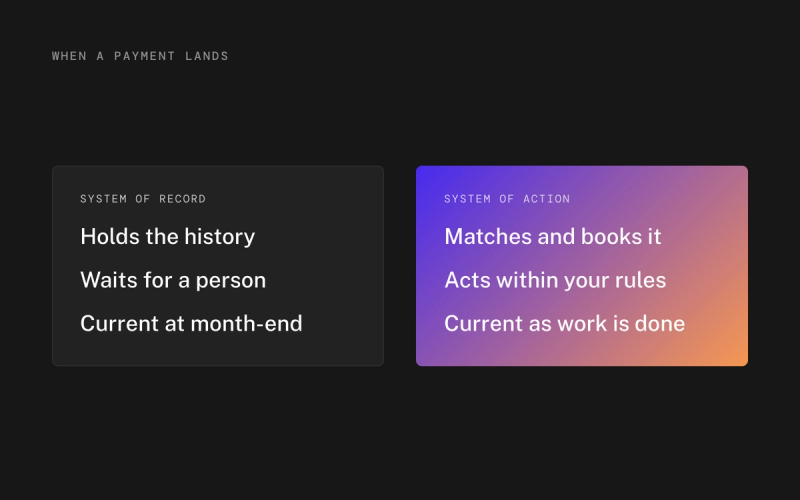
Most of the close file is assembled from information that already exists in the ledger, the bank and the subledgers. That makes it well suited to agents, which can do the preparation continuously during the month rather than all at once after it:
- Bank lines are matched and booked as they arrive, so bank reconciliations are current every day
- Supplier invoices are checked and coded on arrival, and annual or multi-month invoices are flagged as prepayments at the moment of booking
- Recurring accruals, prepayment releases and depreciation are prepared for approval on the last day of the month
- Variances above your threshold are found automatically, with a draft explanation based on the entries that caused them
- Every entry records its source, the agent or person who booked it and who approved it
For a controller, the month opens with the reconciliations already done and the drafts already written. Your hours go to the few items an agent could not settle, the adjustments that need your approval and the explanations that should carry your name.
What changes for your auditor?
When the close file exists for every month, the conversation with your auditor changes too. Instead of a long list of requests at the start of fieldwork, you can share the twelve close files, the locked period log and a complete ledger extract on day one. The auditor can test what they need to test without waiting for you to rebuild it.
This usually shortens fieldwork and reduces the number of late adjustments. It also makes interim audit visits more useful, because the months already closed are already documented. Talk to your auditor early about which items they want in which format, and whether they can rely on parts of your monthly review.
What should you do first?
If your close is not yet audit-ready, start in this order:
- Lock your periods. It costs nothing and it immediately stops the numbers from drifting after you report them.
- Reconcile the bank and payment platforms every month, and save the reconciliation with the period.
- Build schedules for accruals and prepayments, even simple ones. They are the most common source of audit adjustments.
- Write variance explanations each month. Keep them short and specific, and store them with the period, so the auditor reads them instead of requesting them.
- Agree the close file format with your auditor before year-end, so you produce what they will actually use.
Requirements differ between companies and auditors, so check the details with your own accountant or auditor.
Where does Thred fit?
Thred's ledger books every transaction as it happens, under your rules, with the source document, the agent or person who booked it and the approver recorded on every entry. Statements are current at any moment, and accruals, depreciation and revenue recognition are prepared for your approval at month-end. If you want to keep your current accounting software, Thred Layer brings the same agents on top of it in two-way sync.
For controllers and finance leads who want every month to close audit-ready, book a demo.
Frequently asked questions
What is a month-end close file?
The set of evidence kept for each month, such as bank, receivables, payables, VAT and payroll reconciliations, schedules for accruals, prepayments and fixed assets, and a variance review. Each item has a preparer, reviewer and date.
What is flux analysis in accounting?
Flux or variance analysis compares account balances with earlier periods and requires an explanation for movements above a threshold, for example more than 10% and €5,000. It often reveals booking errors.
Why lock periods after the month-end close?
A lock stops entries being posted to a month you have already reported, so numbers do not drift. Any reopening should be logged with who did it, when and why.
How do you book an annual licence paid upfront?
Record it as a prepayment on the balance sheet and release one twelfth to the profit and loss each month the licence covers. Booking it fully as an expense overstates costs in the month of the invoice.
Can month-end close preparation be automated?
Much of it can, since reconciliations, recurring adjustments and variance detection draw on data already in the ledger. A person still decides the items the agent could not resolve and approves anything that changes the reported numbers.
Sources
Read next
- What auditors look for in journal entry testing, and how to be ready
- Month-end close in three days for a small finance team
- Year-end close in the Netherlands: a practical checklist for small companies
Where Thred comes in
Thred’s own general ledger, built for agents. Every transaction is booked as it happens, under your rules, and traceable back to its source.