Deferred revenue for SaaS annual plans: how to book it and release it monthly
An annual plan paid upfront is not a year of revenue in January. How to book deferred revenue, release it each month and handle mid-month starts and cancellations.

Manoj Tutika6 min read

Working on this yourself? Talk to Mark, our co-founder. We’re here to solve it with you.
On this page
Deferred revenue is money a customer has paid or been invoiced for a service you have not delivered yet. For a SaaS annual plan, you book the full invoice to a deferred revenue liability on day one and release one month's share to revenue each month, until the plan ends and the liability is zero.
If you are a founder or finance lead at a SaaS company that sells annual plans, you have seen what happens without it. January looks like a record month, the rest of the year looks like a slump, and every investor update needs a footnote. Revenue recognition fixes that, and it is less work than it sounds once the pattern is in place.
Why can't you book an annual plan as revenue upfront?
Because you have not earned it yet. When a customer pays €1,200 in January for twelve months of software, you owe them eleven more months of service. Until you deliver it, that money is a liability on your balance sheet, not income.
IFRS 15, Dutch GAAP and the UK's FRS 102 all recognise revenue as the service is delivered. For a subscription delivered evenly over time, that means spreading revenue evenly over the subscription period. The IFRS 15 standard is the reference most SaaS companies point to. Your accountant will confirm which framework applies to your annual accounts.
The practical reasons matter as much as the rules.
- Your monthly profit and loss reflects the business you actually ran that month.
- Gross margin and burn are comparable month to month.
- Your balance sheet shows how much service you still owe customers, which matters in due diligence and when a customer asks for a refund.
How do you book an annual SaaS invoice?
Take the simplest case. A Dutch B2B customer signs an annual plan of €1,200.00 excluding VAT, starting 1 January. You invoice upfront, with 21% VAT.
On the invoice date, book:
- Debit accounts receivable €1,452.00.
- Credit deferred revenue €1,200.00.
- Credit VAT payable €252.00.
When the customer pays, debit the bank and credit accounts receivable €1,452.00, as with any invoice.
Then, at the end of every month from January to December:
- Debit deferred revenue €100.00.
- Credit subscription revenue €100.00.
After twelve months, deferred revenue for this customer is zero and you have recognised €1,200.00 of revenue, exactly the value of the contract.
When is VAT due on an annual plan?
VAT follows the invoice, not the revenue schedule. In the Netherlands, VAT is generally due for the period in which you issue the invoice, so the €252.00 goes on the VAT return for the quarter or month of the invoice date, even though revenue is released over twelve months.
That is why the VAT line in the entry above sits next to the receivable and not in the monthly release. Do not spread VAT across the year along with revenue. UK VAT has its own tax point rules for invoices and payments, and selling to customers in other EU countries brings in reverse charge or OSS. If any of that applies, or you invoice in instalments, check the timing with your accountant.
How do you handle plans that start mid-month?
Real subscriptions rarely start on the first of the month. You have two common methods.
The first is to release by month and count the starting month as a full month, or as zero. It is simple and acceptable when amounts are small, as long as you apply it consistently.
The second, and the more precise, is to release by day. Take an illustrative annual plan of €3,650.00 excluding VAT, running from 15 January 2026 to 14 January 2027. That is 365 days, so the plan is worth €10.00 per day.
- January 2026 has 17 days in the period (15 to 31 January), so you release €170.00.
- February has 28 days, so you release €280.00.
- March through December release €10.00 per day of the month, from €300.00 for 30-day months to €310.00 for 31-day months. Together, February to December cover 334 days, or €3,340.00.
- January 2027 has 14 days left, so you release the final €140.00.
The total is €170.00 + €3,340.00 + €140.00 = €3,650.00, and the deferred revenue balance for this plan ends at exactly zero.
Billing tools work the same way. Stripe's revenue recognition, for example, defers each invoice line and spreads it evenly over that line's service period. Release by service period is the method that stays accurate when plans start, upgrade and cancel on random days.
What happens when a customer cancels or upgrades?
This is where a monthly schedule in a spreadsheet usually breaks.
Cancellation with a refund
Say the €1,200.00 customer from the first example cancels after four months and you refund the unused eight months. After four releases of €100.00, the deferred revenue balance for this customer is €800.00.
Issue a credit note for €800.00 plus €168.00 VAT, and book:
- Debit deferred revenue €800.00.
- Debit VAT payable €168.00.
- Credit accounts receivable (or the bank, if you refund directly) €968.00.
Deferred revenue is now zero for this customer, revenue stays at the €400.00 you actually earned, and the VAT correction lands in the period of the credit note.
Cancellation without a refund
If your terms say the customer keeps access until the end of the term and gets nothing back, keep releasing as planned. If the customer loses access straight away and gets no refund, release the remaining balance to revenue at the point of cancellation, since there is nothing left to deliver. Agree the policy once with your accountant.
Upgrades
When a customer upgrades mid-term, your billing system will usually issue a prorated invoice for the difference. Treat it as a new, shorter plan. Book it to deferred revenue and release it over the remaining months of the term, next to the original schedule.
How do you check deferred revenue at month-end?
One check is enough, and it is worth running every month.
The deferred revenue balance in your ledger should equal the total value of service you still owe across all active plans, according to your subscription system. If your billing tool says customers have €84,300.00 of unused subscription time left on 31 August, your ledger should show €84,300.00 of deferred revenue on that date.
If the two differ, the usual causes are:
- A credit note or refund booked to revenue instead of deferred revenue.
- A plan cancelled in the billing system but still releasing in the ledger.
- An annual invoice booked straight to revenue by mistake.
- A release that was skipped in a month with a holiday close.
Run the check by customer when the totals differ. The mismatch is almost always one or two plans.
What changes when an agent runs revenue recognition?
Revenue recognition is rule-based, which is exactly why it suits an agent and exactly why spreadsheets break on it.
- When an invoice is created, the agent reads the service period from the invoice lines and builds the release schedule for that plan.
- At month-end, it prepares the release entries for every active plan and presents them for approval as one batch.
- Credit notes, cancellations and upgrades update the schedule the moment they are issued, not at the next close.
- Every month, it compares deferred revenue in the ledger with the unused subscription value in your billing system and explains any difference by customer.
The controller stops maintaining the schedule and starts reviewing it.
Can this run without a monthly spreadsheet?
It should. The logic is mechanical: an invoice with a service period creates a schedule, and the schedule releases on a fixed rule. A spreadsheet works for twenty customers. At two hundred, with upgrades and cancellations every week, it becomes the most fragile file in the finance team.
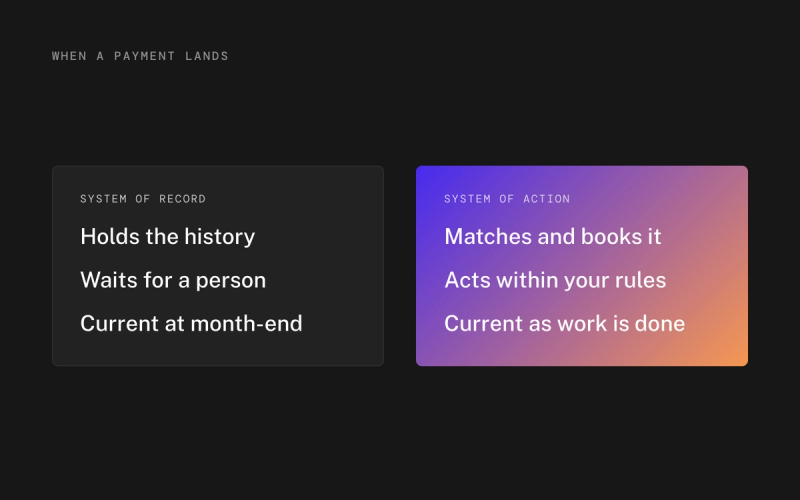
In Thred's own Thred Ledger, revenue recognition is one of the agents that prepares the monthly close. It reads the service period from each invoice, keeps the schedule per customer, books the release under your rules and asks you to approve it, so deferred revenue is current every day instead of rebuilt at year-end. Companies on another ledger can run the same agent through Thred Layer.
For a founder, that means a profit and loss you can put in front of investors without a footnote. For a finance lead, it means one less schedule to maintain and a close that starts with the hard part already done. See how this fits growing businesses.
Want to see revenue recognition handled by an agent? Book a demo.
Frequently asked questions
Is deferred revenue a liability or an asset?
It is a liability. It represents service you have been paid or invoiced for but still owe the customer. It turns into revenue as you deliver the service.
Is VAT spread over the year along with deferred revenue?
No. VAT generally follows the invoice, so in the Netherlands it is due for the period in which the invoice is issued. Only the revenue is released over the subscription term. UK tax point rules differ in detail, so check with your accountant.
Should I release deferred revenue monthly or daily?
Daily release, based on the exact service period, is the most precise and handles mid-month starts and cancellations cleanly. Monthly release is acceptable for small amounts if applied consistently.
What happens to deferred revenue when a customer cancels?
If you refund the unused period, the credit note reduces deferred revenue and VAT. If the customer loses access without a refund, the remaining balance is released to revenue at cancellation.
How do I check that my deferred revenue balance is right?
Compare the ledger balance to the total unused subscription value in your billing system on the same date. Differences usually trace back to one or two plans.
Sources
Read next
- SaaS finance: revenue recognition, subscriptions, deferred revenue and agents
- Handing journal entries to an agent: a four-week plan for controllers
- OSS VAT for EU e-commerce: when it applies, the €10,000 threshold, and how to book it
Where Thred comes in
Thred’s own general ledger, built for agents. Every transaction is booked as it happens, under your rules, and traceable back to its source.