SaaS metrics from your books: ARR, MRR, churn, burn and runway
Billing, bank and P&L never show the same number for the same month. How to define ARR, churn, burn and runway so every figure traces back to the books.

Manoj Tutika7 min read

Working on this yourself? Talk to Mark, our co-founder. We’re here to solve it with you.
On this page
SaaS metrics are a small set of numbers that describe a subscription business: recurring revenue (MRR and ARR), how much of it you keep (churn and retention), and how long your cash lasts (burn and runway). They are only useful if they tie back to your books, so the ARR in your board deck can be explained from the revenue and cash in your ledger.
If you are the founder or finance lead of a SaaS company with a few hundred customers and a board update due every month, you know the moment. A Dutch customer pays for an annual plan of €12,000.00 in January. Your billing tool adds €1,000.00 to MRR, the P&L shows €1,000.00 of revenue for the month, and the bank receives €14,520.00 including 21% VAT. You get from the bank figure to the other two in two steps: take out the €2,520.00 of VAT, then spread the remaining €12,000.00 over twelve months. The job is to define each metric once, calculate it from the right source and be able to walk from one figure to the next.
What is the difference between MRR, ARR and revenue?
MRR, monthly recurring revenue, is the normalised monthly value of all active subscriptions on a given date. A customer on an annual plan of €12,000.00 contributes €1,000.00 to MRR every month, even though they paid once. One-off fees, setup work and usage overages that do not recur are left out. MRR is always measured excluding VAT.
ARR, annual recurring revenue, is MRR multiplied by twelve. It is a run rate, not a forecast and not this year's revenue.
Revenue in your P&L is what you have earned in the period under your accounting framework. Under IFRS 15, Dutch GAAP and UK FRS 102 alike, subscription revenue is recognised over the period the service is delivered. An annual plan paid upfront goes onto the balance sheet as deferred revenue and is released into the P&L month by month.
That is why the three numbers differ. Billing reflects what you invoiced, revenue reflects what you earned, and MRR reflects what you would earn in a month if nothing changed. In a healthy setup, recognised subscription revenue for a month lands close to the average MRR for that month, and you can explain the gap line by line.
How do you build an MRR waterfall?
An MRR waterfall, sometimes called an MRR bridge, explains how you got from last month's MRR to this month's. Every subscription change falls into one of four movements:
- New. MRR from customers who were not paying last month.
- Expansion. Extra MRR from existing customers, through more seats, a higher tier or a price increase.
- Contraction. Lost MRR from customers who stay but pay less.
- Churn. All the MRR of customers who left.
Opening MRR plus new and expansion, minus contraction and churn, equals closing MRR. If the bridge does not close, a subscription change has been missed or counted twice, and that is worth finding before anyone sees the chart.
A worked example
Take an illustrative month for a Dutch SaaS company:
- Opening MRR of €40,000.00
- New business adds €4,500.00
- Expansion adds €1,800.00
- Contraction removes €700.00
- Churn removes €1,600.00
Closing MRR is €40,000.00 + €4,500.00 + €1,800.00 − €700.00 − €1,600.00 = €44,000.00. ARR at month-end is €44,000.00 × 12 = €528,000.00.
How should you calculate churn and retention?
Churn is where definitions vary most, so write yours down and keep it.
- Logo churn is the share of customers who left. If 6 of 300 customers cancel, logo churn is 2%.
- Gross revenue churn is lost MRR from contraction and churn, divided by opening MRR. In the example above that is (€700.00 + €1,600.00) / €40,000.00 = 5.75% for the month.
- Net revenue retention looks only at customers you had at the start: opening MRR plus expansion, minus contraction and churn, divided by opening MRR. Here that is €39,500.00 / €40,000.00 = 98.75% for the month.
Net revenue retention below 100% means your existing customers shrink as a group, and every euro of growth has to come from new business. Above 100%, the base grows on its own. Investors tend to read this number before any other, so it pays to get the definition right and stick with it.
Two practical choices matter. Decide whether a customer who pauses counts as churned or not, and decide when an annual customer who does not renew counts as lost: on the renewal date, or at the end of any grace period. Both are defensible. Changing them between board meetings is not.
How do you get burn and runway from the books?
Burn and runway are cash metrics. Calculate them from bank movements, not from the P&L, because the P&L includes non-cash items and leaves out cash that has not yet been earned.
- Net burn is everything that left your bank and payment accounts in a month, less everything that came in.
- Runway is cash on hand divided by average net burn.
Continuing the example, cash in for the month is €46,000.00 and cash out is €71,000.00, so net burn is €25,000.00. With €600,000.00 in the bank, runway is €600,000.00 / €25,000.00 = 24 months.
Three things distort burn if you are not careful:
- VAT. Quarterly BTW payments to the Belastingdienst, or VAT payments to HMRC for a UK entity, make some months look much worse than others. Either use a three-month average or show burn before and after VAT.
- Annual prepayments. A large batch of annual renewals in January makes burn look low for that month and high for the next eleven. Average over three to six months.
- Payment provider payouts. Stripe, Mollie and similar providers pay out net of fees and refunds. If you count payouts as cash in, burn is right but revenue analysis is not. Book the gross sales, the fees and the refunds separately.
Why do these metrics need to come from the books?
Because metrics calculated in a separate spreadsheet drift. Someone exports subscriptions, someone else exports the bank, a formula breaks, and by the next funding round the gap between the ARR on the investor slide and the revenue in the jaarrekening filed at the KvK can only be explained by one person, if at all. That walk from ARR to filed revenue is a standard due diligence request, and it is far easier to produce monthly than under a deadline.
When metrics come from the books, each number has a trail:
- MRR comes from active contracts, and recognised subscription revenue in the ledger reconciles to it.
- Deferred revenue on the balance sheet equals the unreleased part of plans paid upfront.
- Burn comes from bank lines that are already matched to invoices and bills.
- Runway uses the same cash balance as your balance sheet.
How do agents change the way you produce these numbers?
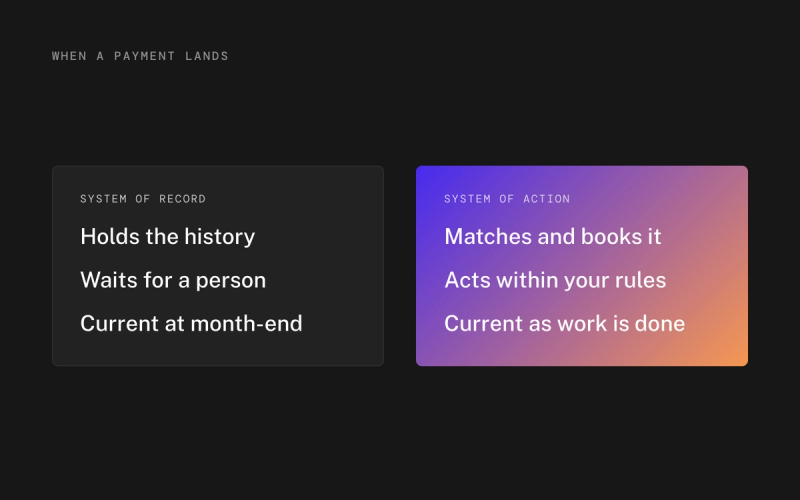
In most small SaaS finance teams, the monthly metrics are a manual project: export subscriptions, export the bank, rebuild the bridge, chase the differences. Agents turn each step into ongoing work that is already done when you need the number.
- Payouts split as they arrive. Each Stripe or Mollie payout is broken into gross sales, fees and refunds and matched to the invoices behind it, so the revenue and cash side of your metrics are current every day.
- Revenue recognised on schedule. For annual and quarterly plans, the agent prepares the deferred revenue release each month from the contract dates, and you approve it. Deferred revenue on the balance sheet stays equal to what is still unearned.
- Subscription changes classified. Every change in a customer's recurring amount is labelled as new, expansion, contraction or churn, using the definitions you wrote down. The waterfall builds itself and still has to close, so a missed change is flagged rather than hidden.
- Questions answered from live numbers. You ask for the MRR bridge for the quarter, net revenue retention for annual customers or runway with two extra hires, and get the answer with the entries behind it.
The definitions, and what you tell your board about them, stay your decisions. The agents make sure every figure comes from the same books your accountant will see.
This is why we built Thred Ledger to book transactions as they happen, under your rules and the local accounting standards, with every entry traceable back to its source.
What should you report every month?
For a founder of a growing SaaS company, five numbers each month are enough:
- Closing MRR and ARR, with the MRR waterfall
- Net revenue retention and gross revenue churn, trailing three months
- Recognised revenue, gross margin and operating result from the P&L
- Net burn, trailing three-month average, and runway in months
- Deferred revenue balance and the cash collected for it
Keep the definitions on the last page of every update. When a number changes because the definition changed, say so.
If you want these numbers without the spreadsheet, see how Thred works for businesses, or book a demo to see an MRR bridge built from your own ledger.
Frequently asked questions
Is ARR the same as annual revenue?
No. ARR is a run rate based on the recurring subscriptions active on a given date. Annual revenue is what you earned over the year under your accounting framework, including one-off fees and any changes during the year.
Why does MRR differ from revenue in the P&L?
Revenue is recognised over the period the service is delivered, while MRR is a snapshot of active subscriptions. Annual plans paid upfront, one-off fees and mid-month changes all create differences. Those differences should be explainable line by line.
What is a good net revenue retention?
Above 100% means existing customers grow as a group through expansion, even after churn and downgrades. Below 100% means every euro of growth has to come from new customers. What counts as good depends on your segment and stage.
Should runway be based on the P&L or on cash?
On cash. Use bank and payment account movements, averaged over three to six months to smooth out quarterly VAT payments and annual prepayments.
Do annual subscriptions paid upfront count as revenue immediately?
No. Under IFRS 15 and comparable local standards, the payment is recorded as deferred revenue and released into revenue month by month as the service is delivered.
Sources
Read next
- Real-time books: what changes when your ledger is always current
- Deferred revenue for SaaS annual plans: how to book it and release it monthly
- Evaluating accounting AI: how to test an agent on your real books
Where Thred comes in
Thred’s own general ledger, built for agents. Every transaction is booked as it happens, under your rules, and traceable back to its source.