Multi-currency bookkeeping: realised vs unrealised FX results, with worked examples
A GBP sales invoice, a SEK bill and a sterling bank account, worked through in euros: when an exchange difference is realised, when it is unrealised, and the journals.
David van Duijn6 min read

Working on this yourself? Talk to Mark, our co-founder. We’re here to solve it with you.
On this page
A realised exchange result is the gain or loss you lock in when a foreign-currency invoice is actually paid at a different rate from the one you booked it at. An unrealised result is the paper gain or loss you record at period end when you revalue open foreign-currency balances, such as unpaid invoices and bank accounts, to the closing rate.
If you are the finance lead at a Dutch company that sells to the UK, buys from suppliers in Sweden or Poland, or holds a sterling account, you meet both every month. Exchange differences are rarely large, but they are a classic source of small, unexplained balances on debtor and creditor accounts, and of month-end results that move for reasons nobody can trace.
Here are three worked examples in euros, with journals that balance to the cent. Rates are quoted the way the European Central Bank publishes them, as the amount of foreign currency for one euro.
What is the difference between realised and unrealised FX results?
Your books are kept in euros, your functional currency. A transaction in another currency is translated into euros on the day it is booked. From then on, two things can happen.
- The item is settled. The customer pays or you pay the supplier. The euros that actually move differ from the euros you booked, and the difference is final. That is a realised result.
- The item is still open at period end. Under IFRS (IAS 21), UK FRS 102 (Section 30) and, in most cases, Dutch GAAP, open monetary items in a foreign currency are translated at the closing rate on the balance sheet date. The difference against the booked amount is unrealised, because the rate can still move before settlement.
Monetary items are those settled in a fixed amount of currency: bank balances, debtors, creditors and loans. Non-monetary items such as equipment bought in pounds stay at the historical rate and are not revalued. Your accountant can confirm the policy for your annual accounts and for corporate income tax.
Example 1: how do you book a realised loss on a GBP sales invoice?
On 10 March 2026 you invoice a UK business customer GBP 8,000.00 for consulting work. The ECB reference rate that day is 0.8400 GBP per euro. No Dutch VAT applies here, because a service to a business customer outside the EU is generally not taxed in the Netherlands, but check the specifics with your accountant.
GBP 8,000.00 / 0.8400 = €9,523.81.
10 March 2026, sales invoice
- Debit Trade debtors (GBP 8,000.00) €9,523.81
- Credit Revenue, services outside EU €9,523.81
The customer pays the full GBP 8,000.00 on 15 April 2026, and your bank converts it at 0.8550. That is GBP 8,000.00 / 0.8550 = €9,356.73.
15 April 2026, payment received
- Debit Bank €9,356.73
- Debit Exchange differences, realised €167.08
- Credit Trade debtors (GBP 8,000.00) €9,523.81
The customer paid exactly what they owed, so the debtor must close to zero in both currencies. The €167.08 that the euro side is short is a realised exchange loss. It belongs in the financial results, not in revenue, and you should never "fix" it by booking a discount or editing the invoice.
If this invoice had still been open at 31 March, you would also have revalued it at month-end, which is what the next example shows.
Example 2: what happens when a bill stays open over month-end?
On 20 June 2026 you receive an invoice from a Swedish supplier for SEK 50,000.00. The rate is 11.2000 SEK per euro.
SEK 50,000.00 / 11.2000 = €4,464.29.
20 June 2026, purchase invoice
- Debit External services €4,464.29
- Credit Trade creditors (SEK 50,000.00) €4,464.29
For simplicity, this example leaves out the reverse-charge VAT that applies to most services bought from businesses in other EU countries, which you report in box 4b and deduct in box 5b of the Dutch return. Your accountant will set that up once.
At 30 June the bill is unpaid. The closing rate is 11.0500, so the SEK 50,000.00 you owe is now worth SEK 50,000.00 / 11.0500 = €4,524.89. The krona strengthened, and the liability grew by €60.60.
30 June 2026, month-end revaluation
- Debit Exchange differences, unrealised €60.60
- Credit Trade creditors (SEK 50,000.00) €60.60
You pay on 15 July 2026 at 11.3000, so SEK 50,000.00 costs you €4,424.78. The creditor now stands at €4,524.89 after revaluation.
15 July 2026, payment
- Debit Trade creditors (SEK 50,000.00) €4,524.89
- Credit Bank €4,424.78
- Credit Exchange differences, realised €100.11
Over the whole life of the bill the result is €4,464.29 − €4,424.78 = €39.51 in your favour. June shows a €60.60 unrealised loss, July a €100.11 realised gain, and together they make that €39.51. The total is the same whichever way you book it; the revaluation only moves part of it into the period where the rate moved.
Revalue and keep, or revalue and reverse?
There are two common methods, and both are fine as long as you pick one.
- Revalue and keep, as above. The revaluation stays on the creditor, and the realised result at payment is measured against the revalued amount.
- Revalue and reverse. You reverse the €60.60 on 1 July, so the creditor is back at €4,464.29. At payment, the full €39.51 is booked as realised. June still shows the unrealised loss, July shows the reversal (a €60.60 unrealised gain) plus €39.51 realised.
Reversing makes it easier to see the true realised result per invoice. Keeping avoids a reversal run every month. Many ledgers do one of the two automatically, so check which one yours uses before you add manual entries on top.
Example 3: how do you revalue a foreign-currency bank account?
You hold a sterling account for your UK customers. At 31 March 2026 it contains GBP 20,000.00, carried in your books at €23,500.00 from earlier transactions. The closing rate is 0.8480.
GBP 20,000.00 / 0.8480 = €23,584.91.
31 March 2026, bank revaluation
- Debit Bank, GBP account €84.91
- Credit Exchange differences, unrealised €84.91
Bank revaluations are the step most often forgotten. If you skip it, the euro balance of the account in your ledger slowly drifts away from what the bank shows converted at today's rate, and every reconciliation contains a difference nobody can explain.
How should you set this up in your ledger?
- Two accounts, not one. Keep realised and unrealised exchange differences apart, so you can see what is final and what can still move. Both sit in the financial results.
- One rate source, applied consistently. The ECB publishes euro reference rates every working day, and using them for bookings and revaluations is common and easy to defend.
- Record the currency amount on every line. A debtor or creditor in a foreign currency must be tracked in that currency, or you cannot close items properly.
- Revalue every period end. Debtors, creditors, bank accounts and loans in foreign currency, at the closing rate on the last day.
- Keep VAT in euros. On Dutch VAT the amount of VAT due must be expressed in euros, even if the invoice is in another currency, and the EU VAT Directive sets which exchange rates may be used. Ask your accountant how your invoices should show it.
How do AI agents change multi-currency bookkeeping?
The mistakes in foreign-currency bookkeeping are rarely conceptual. They are a wrong rate, a forgotten revaluation, or a receipt that does not match its invoice because the bank deducted a fee. These are exactly the steps an agent does well.
- The rate is right on every line. The agent books each foreign-currency invoice at the rate from your chosen source on the transaction date, and records the currency amount alongside the euros.
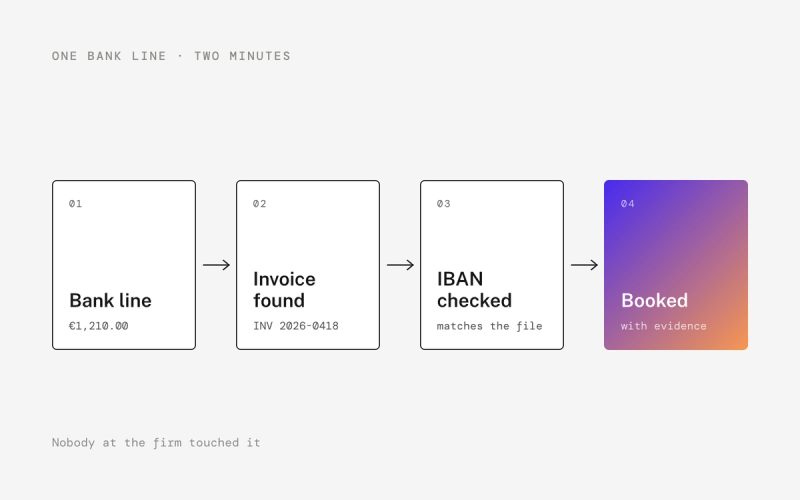
- Payments close their invoices properly. When a GBP receipt lands, the agent matches it to the invoice, closes it to zero in both currencies and splits any difference into an exchange result and a bank fee, instead of leaving a few euros open on the debtor.
- Month-end revaluation just happens. Open debtors, creditors and bank accounts in foreign currency are revalued at the closing rate, using the method you chose, every period.
- Results come with an explanation. When the exchange line moves, you can see which invoices and balances caused it, rather than one unexplained total.
You decide the policy once. The agent applies it every day.
Where Thred fits
In Thred, bank lines and payments are matched to invoices and booked as they arrive, under your rules and the local accounting standards, and every entry stays traceable to its source, so the profit and loss is current at any moment instead of after month-end. That is the idea behind Thred Ledger. If you would rather keep your current accounting software, Thred Layer runs the same agents on top of it.
If foreign-currency payments leave small differences all over your debtors list, book a demo.
Frequently asked questions
Where do exchange differences go in the profit and loss account?
Exchange differences are usually reported in the financial results, below operating profit, rather than in revenue or cost of sales. Keeping separate accounts for realised and unrealised differences makes it clear which part is final. Your accountant will confirm the presentation for your annual accounts.
Which balances must be revalued at month-end?
Monetary items in a foreign currency: bank accounts, trade debtors, trade creditors and loans. Under IAS 21 and UK FRS 102 they are translated at the closing rate on the balance sheet date. Non-monetary items, such as equipment bought in a foreign currency, stay at the historical rate.
Which exchange rate should a Dutch company use for bookkeeping?
Use one consistent, documented source. The European Central Bank publishes euro reference rates every working day, and many companies use them for both bookings and revaluations. For VAT purposes, the EU VAT Directive sets which rates may be used, so check that with your accountant.
Should unrealised exchange revaluations be reversed?
Both methods are acceptable. Reversing the revaluation on the first day of the next period lets you see the full realised result per invoice at payment. Keeping it means the realised result is measured against the revalued amount. The total over the life of the item is the same either way.
Does a foreign-currency invoice need VAT in euros?
For Dutch VAT, the amount of VAT on the invoice must be stated in euros, even if the rest of the invoice is in another currency. The EU VAT Directive allows invoices in any currency provided the VAT amount is expressed in the national currency of the member state.