Bookkeeping for a group of companies: intercompany and consolidation
Three or more entities means three or more ledgers, a web of intercompany balances and a consolidated view nobody has. How to keep the group's books clean every month.
David van Duijn7 min read

Working on this yourself? Talk to Mark, our co-founder. We’re here to solve it with you.
On this page
Multi-entity bookkeeping means keeping a separate, complete set of books for every legal entity in a group, recording each transaction between them on both sides, and then combining the entities into one consolidated view with the internal transactions removed. The entity books are for filings and tax. The consolidated view is for running the business.
Two companies are manageable with care. Once you have three or more, say a holding, a Dutch operating BV and a UK subsidiary, the work changes character. Intercompany flows multiply, currencies enter, and the question "how is the group actually doing?" no longer has an answer you can read off a single report. This post is for founders, finance leads and controllers of those small groups.
What changes when a group grows past two entities?
With two entities there is one intercompany relationship. With three there are three possible pairs, with four there are six. Each pair can have a current account, recharges, management fees, loans and interest. Each of those needs to be booked twice, once in each ledger, with the same amount and date.
Three other things arrive at roughly the same time:
- More than one currency. A UK Ltd keeps its books in GBP. Its numbers have to be translated to EUR before they mean anything next to the Dutch entities.
- Different VAT regimes. Services between a Dutch BV and a UK Ltd are cross-border, so the invoice and the VAT treatment differ from a purely Dutch recharge.
- Different deadlines and filings. Each entity has its own VAT returns, annual accounts and corporate tax return, often with different accountants.
Most groups end up with entity books that are each roughly right and a consolidated picture in a spreadsheet one person understands.
How should you set up the books for a group?
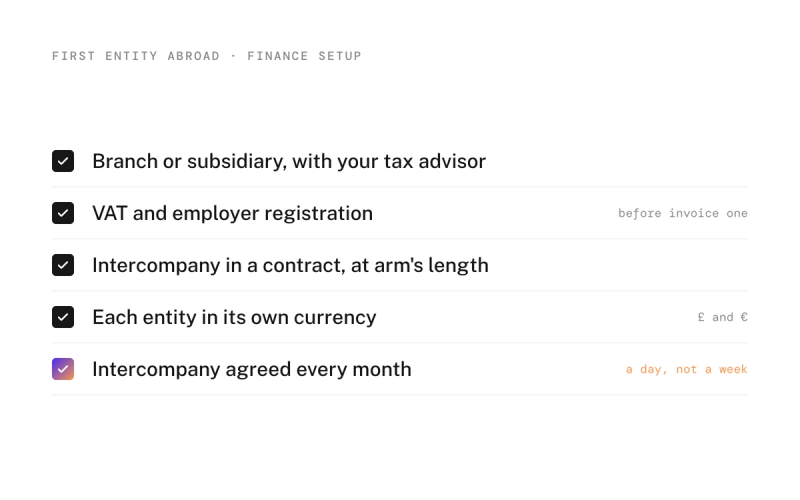
Before reconciliation and consolidation, get the structure right. Three decisions save most of the pain later.
Use one chart of accounts across all entities
Every entity should use the same account structure, with the same numbers meaning the same thing. Local requirements can be met with extra sub-accounts, not with a different scheme. If "Software subscriptions" is 4610 in the Dutch BV and 7302 in the UK Ltd, every consolidation starts with a mapping exercise, and mappings drift.
Give every intercompany relationship its own accounts
Do not book intercompany items on general receivables and payables. Create a dedicated intercompany receivable and payable per counterparty entity, and a dedicated intercompany revenue and cost account. "Due from Northwind Services Ltd" is something you can reconcile. A customer line called "Northwind" in a list of 400 customers is not.
Agree the rules in writing
Write down, once, how each recurring flow works: which entity invoices, how often, in which currency, at which exchange rate, and who books the other side. Management fees and recharges between group companies should be at arm's length and documented, both for tax and for whoever audits or reviews the accounts. Your accountant can tell you what level of documentation your structure needs.
How do you reconcile intercompany balances?
Intercompany reconciliation is the monthly check that each pair of entities agrees about what they owe each other. The receivable in one ledger should equal the payable in the other, and intercompany revenue on one side should equal intercompany cost on the other.
Do it every month, not only at year-end. A difference found in the month it arises takes minutes to explain, and an afternoon of digging eleven months later.
A practical routine:
- Cut off at the same date. Every entity books its intercompany items up to the same month-end before anyone compares.
- List the balances per pair. For each relationship, put the receivable next to the payable, and the revenue next to the cost.
- Translate on the same basis. For a GBP entity, compare at the same month-end rate on both sides, so you do not chase differences that are only exchange rates.
- Explain every difference. Almost all of them fall into four groups: an invoice booked by one side and not yet by the other, a payment in transit, a different exchange rate, or a booking on the wrong account.
- Correct at the source. Fix the entity that is wrong, with a proper entry. Do not plug the difference in the consolidation spreadsheet.
In the illustrative example above, the Dutch operating BV shows €12,000.00 receivable from the UK Ltd, while the Ltd shows a payable worth €11,400.00. The €600.00 gap is a recharge invoice the BV sent on the last day of the month that the Ltd has not booked yet. The fix is to book it in the Ltd in the same period, not to adjust the group numbers.
What is consolidation, and what gets eliminated?
Consolidation adds the entities together as if they were one company, then removes everything that only happened inside the group. A sale from one entity to another is not revenue for the group, it is money moving from one pocket to another.
For a small group, eliminations usually come down to four items:
- Intercompany revenue and costs. Management fees, recharges and internal sales are removed from both revenue and costs.
- Intercompany receivables and payables. Current accounts and unpaid internal invoices are removed from both sides of the balance sheet.
- Intercompany loans and interest. The loan and the interest income and expense cancel out.
- Investments against equity. The holding's investment in each subsidiary is removed against the subsidiary's share capital.
Eliminating revenue and costs by the same amount does not change group profit, which makes a useful check. If your eliminations move the bottom line, something is booked on only one side, or internal goods are still sitting in stock with a margin on them.
A worked example
Take an illustrative group of three entities for one month, with the UK Ltd already translated to EUR.
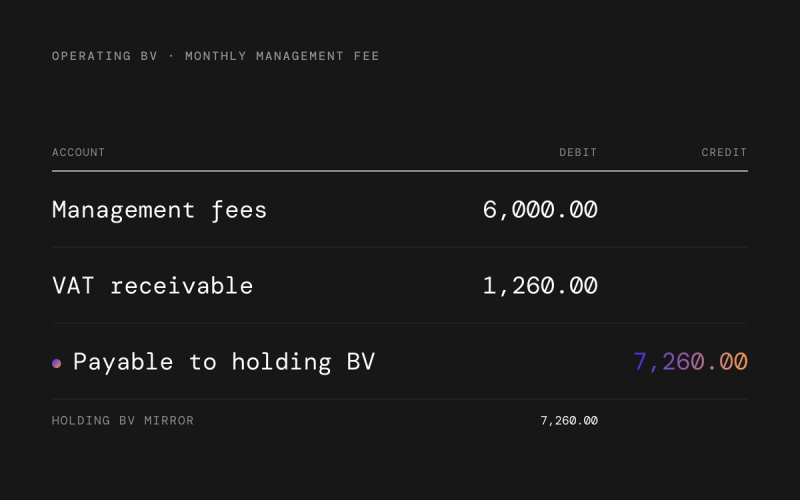
- Holding BV charges each subsidiary a management fee of €6,000.00. Its revenue is €12,000.00, all intercompany.
- Operating BV has external revenue of €180,000.00 and recharges €12,000.00 of development work to the UK Ltd. Its revenue is €192,000.00. It pays a €6,000.00 management fee.
- UK Ltd has external revenue of €60,000.00. It pays a €6,000.00 management fee and the €12,000.00 recharge, so €18,000.00 of intercompany costs.
Added together, the three entities report €264,000.00 of revenue. Intercompany revenue is €24,000.00 (€12,000.00 in the holding plus €12,000.00 in the operating BV). Intercompany costs are also €24,000.00 (€6,000.00 in the operating BV plus €18,000.00 in the Ltd). Eliminating both leaves consolidated revenue of €240,000.00, which is exactly the external revenue of €180,000.00 plus €60,000.00. Group profit is the same before and after.
What about VAT and filings in a group?
VAT follows the legal entities, not the group. Two points come up in almost every small group, and both are worth confirming with your accountant for your own structure.
- Dutch entities and fiscal unity. A Dutch holding that charges a management fee to a Dutch subsidiary normally charges 21% BTW. If the entities form a fiscal unity for VAT, supplies within the unity are outside the scope of VAT and the unity files one return.
- Services to and from the UK. Since Brexit, the UK is outside the EU VAT area. For business-to-business services the place of supply is generally where the customer is established, so a Dutch BV recharging services to a UK Ltd usually invoices without Dutch VAT and the Ltd accounts for UK VAT under the reverse charge.
On filings, each entity prepares its own annual accounts. Whether the group must also prepare and file consolidated accounts depends on its size and structure. Both Dutch and UK law exempt many small groups from that obligation, but a bank, an investor or a buyer will usually still ask for a consolidated view. Check the exemption for your group before you rely on it.
How do agents change multi-entity bookkeeping?
Look at the routine above again. Book the same management fee every month, mirror every recharge, compare every pair, translate at the month-end rate, eliminate the same lines. Almost none of it needs judgement. It needs consistency, and that is where agents change the work for a finance lead or controller.
- Mirroring at the moment of booking. When one entity books an intercompany invoice, an agent drafts the counterpart entry in the other entity straight away, on the dedicated intercompany accounts, with the same amount and date and the original invoice attached. The €600.00 recharge from the example never becomes a month-end difference.
- Reconciliation as a standing check. Instead of a monthly comparison, every intercompany pair is compared each time either side changes. A difference shows up with its likely cause, such as an unbooked invoice, a payment in transit or a rate difference, so you review an explanation rather than hunt for one.
- Recurring flows booked under your rules. Management fees, interest on current accounts and standard recharges follow the agreements you wrote down. The agent books them each period and asks when something does not fit, for example an amount that differs from the contract.
- Eliminations prepared, not typed. Because intercompany items sit on their own accounts, the elimination entries for the consolidated view can be prepared from the ledger itself. You review and approve them.
What stays with you are the decisions: the group structure, transfer pricing, the treatment of anything unusual and the sign-off. The agents take the keying, matching and chasing out of the loop.
At Thred we built Thred Ledger around this. It keeps one ledger per entity, with one view across all of them, so intercompany entries are booked on both sides as they happen and the consolidated numbers are current on any day, not only after a month-end exercise. If you want to keep your existing accounting software per entity, Thred Layer puts agents on top of it to do the mirroring and the monthly checks. And if you are an accounting firm with several group clients, the same checks can run across every administration from one workspace.
Whatever tools you use, the order stays the same: one chart of accounts, dedicated intercompany accounts, every pair reconciled every month, and consolidation as the easy last step.
If your group has outgrown its spreadsheet consolidation, book a demo and we will show you one ledger per entity and one view across them.
Frequently asked questions
What is the difference between intercompany reconciliation and consolidation?
Intercompany reconciliation checks that two entities agree about what they owe each other and what they charged each other. Consolidation comes afterwards and combines all entities into one set of figures, removing the intercompany items. A clean reconciliation makes the consolidation straightforward.
Which items are eliminated in a consolidation?
For a small group, typically intercompany revenue and costs, intercompany receivables and payables, intercompany loans and the interest on them, and the parent's investment in each subsidiary against the subsidiary's share capital. Margins on internal stock that has not been sold yet also need attention.
Should all entities in a group use the same chart of accounts?
Yes, wherever possible. One shared structure means consolidation does not start with a mapping exercise each month. Local requirements can be handled with extra sub-accounts within the same scheme.
Does a Dutch BV charge VAT on services to a UK subsidiary?
For business-to-business services, the place of supply is generally where the customer is established, so a Dutch BV usually invoices a UK company without Dutch VAT and the UK company accounts for VAT under the reverse charge. Confirm the treatment for your services with your accountant.
Do small groups have to file consolidated annual accounts?
Both Dutch and UK law exempt many small groups from preparing consolidated accounts, depending on size and structure. Banks, investors and buyers often still ask for a consolidated view, so most groups prepare one anyway. Check the exemption for your group with your accountant.
Sources
Read next
Where Thred comes in
Thred’s own general ledger, built for agents. Every transaction is booked as it happens, under your rules, and traceable back to its source.