A practical routine for reviewing an agent's bookkeeping work
When an agent books your clients' transactions, your job moves from keying in to reviewing. A daily, weekly and monthly routine built on exceptions, sampling, reconciliations and sign-off.
David van Duijn5 min read

Working on this yourself? Talk to Mark, our co-founder. We’re here to solve it with you.
On this page
Reviewing an agent's bookkeeping means checking the system rather than every entry: clear its exceptions daily, sample its automatic bookings weekly with a bias towards risk, reconcile every balance sheet account monthly, and sign off the period with a record of what you checked. The results of that review then decide how much freedom the agent gets next month.
If you are an accountant at a firm, this is where your hours are going. The agent books most of the transactions in your clients' administrations, and your job is to make sure that what it booked is right. Done well, that takes a fraction of the time keying in used to. Done badly, you either check everything again, which wastes the gain, or you check nothing, which is worse.
What helps is a fixed routine.
Why does agent work need a different review?
A junior bookkeeper makes random mistakes: a typo here, a wrong account there. An agent behaves differently. It applies the same rule consistently, so when it is right it is right every time, and when it is wrong it is wrong in the same way on every similar transaction.
That changes how you review. You do not need to find one needle per haystack. You need to find each wrong rule once, fix it, and confirm that the fix holds. Your review should be designed to surface patterns, not to re-perform the bookkeeping.
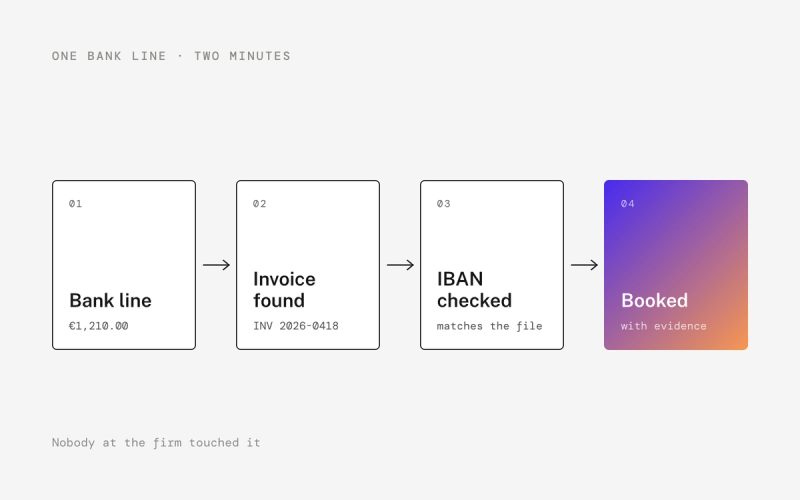
It also helps that an agent leaves a trail. Every booking should show the source document, the bank line, the rule or reasoning used and whether a person approved it. If the software you use cannot show you that, that is the first thing to fix.
What does the routine look like?
Daily: clear the exceptions
The agent should send you only what it cannot decide: a bank line with no matching invoice, a supplier it has not seen before, an amount outside the limit you set, a document that is missing. Work through that queue every day, for ten or fifteen minutes per client group. Exceptions left for a week turn into month-end catch-up.
When you resolve an exception, ask whether it will come back. If it will, turn your answer into a rule, so the agent handles it next time.
Weekly: sample the automatic bookings
This is the core of the review. Take a sample of what the agent booked without asking, and check each item against its source. Build the sample from two parts.
The risk-based part covers everything where a wrong rule would hurt:
- every booking above a value threshold you set per client
- every first booking for a new supplier or customer
- bookings where a rule was created or changed in the last week
- anything with an unusual VAT treatment, such as reverse charge, zero rate or partial deduction
- entries that touch balance sheet accounts other than bank, receivables and payables
The random part is a small number of ordinary bookings, so you also see how the routine work is going.
Monthly: reconcile, then sign off
Before you sign off a period, every balance sheet account should be explained:
- bank and payment provider clearing accounts tie to statements
- receivables and payables subledgers tie to their control accounts
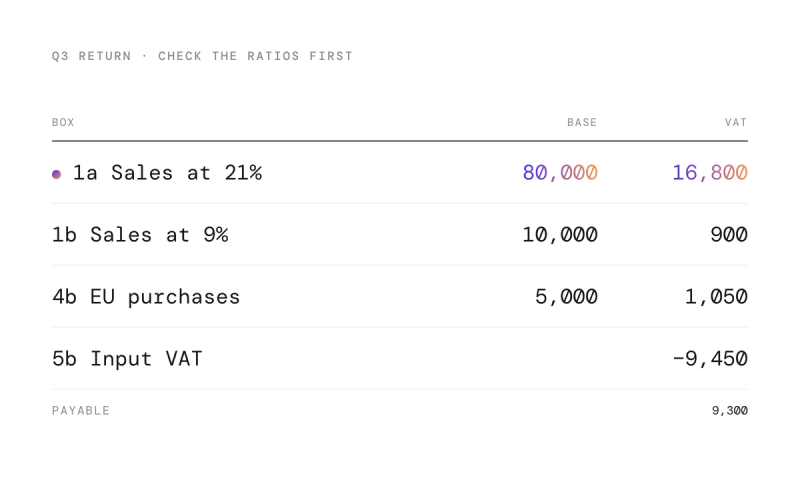
- the VAT accounts agree with the return being prepared
- suspense is zero, or every open item is named
- accruals and prepayments for the month are booked and make sense against last month
Then record the sign-off: who reviewed, what was sampled, what was found and what was changed.
Quarterly: review the rules and the autonomy
Look back over three months of review notes. Which rules caused errors? Which exception types keep coming back? For each client, decide whether the agent's freedom should grow, stay or shrink.
A worked example: one client, one month
Say one of your clients has 600 bank and document transactions in a month. The agent books 560 of them without asking, and sends 40 to the exceptions queue. You resolve the 40 during the month as part of the daily routine.
Over the month, your weekly samples from the 560 automatic bookings add up to:
- 12 bookings above the client's EUR 2,500 threshold
- 15 first bookings for new counterparties
- 20 random bookings
That is 12 + 15 + 20 = 47 items, or about 8% of the automatic bookings. Suppose you find two problems. One new supplier, a software subscription, was booked to general costs instead of software. One random item, a lunch receipt, was booked with full input VAT although the client's policy says otherwise.
Neither is a one-off. The first is a missing rule for a supplier category, the second is a rule that does not reflect the client's policy. You fix both rules, ask the agent to find and correct every other booking they affected, and add both categories to next month's risk-based sample to confirm the fix holds.
You do not widen this client's autonomy this month. If the next two months come back clean, you might.
How do you decide how much freedom an agent gets?
Treat autonomy as something the agent earns per client and per type of work, based on your review results.
A sensible progression is to start every new client with the agent asking before it books, then let it book routine, low-value, well-known transactions on its own once your samples are clean. Keep larger amounts, new counterparties and unusual VAT treatments in the exceptions queue for longer. If a review finds a problem, step back for that category until the fix is proven.
In Thred, each agent can be set to ask first or to run autonomously, and the rules and policies you write down are stored as memories that agents apply as they work. Anything that needs a person lands in one inbox. That makes the routine above something you configure rather than something you remember.
What should a sign-off record contain?
Keep it short and consistent, so a colleague, a reviewer or you in a year can follow it:
- the client and the period
- the number of automatic bookings and exceptions
- what was sampled and why
- findings, and the rule changes made
- the reconciliation status of each balance sheet account
- who signed off, and when
Records like this also matter when you are asked how you know the books are right. Keeping the review trail with the administration is good practice, and in the Netherlands the underlying records generally have to be kept for seven years.
How does this scale across a client portfolio?
The routine only pays off if you run it across all your clients without opening each administration separately. Group clients by risk: new clients and complex ones get larger samples and more frequent review; stable clients with clean history get smaller ones.
With Thred for accounting firms, you work in every client's ledger from one workspace and can run one check across all administrations for unreconciled items, unusual bookings or clients falling behind. The agents run on top of the ledger each client already uses, so the finished entries flow back and your team keeps working where it always has.
If your team is moving from keying in to reviewing, book a demo and we will walk through this routine on your own client set.
Frequently asked questions
How large should a review sample of agent bookings be?
There is no fixed number. Cover every high-risk item, such as bookings above a value threshold and first bookings for new counterparties, then add a small random sample of routine work. Increase the sample for new or complex clients and reduce it as results stay clean.
Why do agent errors repeat?
An agent applies rules consistently, so a wrong rule produces the same mistake on every similar transaction. That is why a review should focus on finding and fixing rules, and then confirming that affected bookings were corrected.
When should an agent be allowed to book without approval?
Start with the agent asking before it books, then allow routine, low-value, familiar transactions once your samples are clean for several periods. Keep large amounts, new counterparties and unusual VAT treatments under review for longer.
What belongs in a bookkeeping sign-off record?
Record the client and period, the number of automatic bookings and exceptions, what was sampled and why, findings and rule changes, the reconciliation status of each balance sheet account, and who signed off and when.
Which reconciliations matter most before signing off a month?
Bank and payment provider clearing accounts against statements, receivables and payables subledgers against control accounts, VAT accounts against the return, and suspense, which should be zero or fully explained.
Sources
Read next
- AI for bookkeeping firms: the work agents already do in your clients' books
- Thred vs Dext: a Dext alternative for practices that want the bookkeeping done, not just captured
- Where does the answer live? Splitting firm work between agents and accountants
Where Thred comes in
Make your firm more efficient with AI, so you have more time for relationships, new customers and advisory work.