Where does the answer live? Splitting firm work between agents and accountants
For firm owners and partners. One test for splitting client work between agents and your team, and how capacity changes when review replaces data entry.

Mark Holleman7 min read

Working on this yourself? Talk to Mark, our co-founder. We’re here to solve it with you.
On this page
The cleanest way to split an accounting firm's work between agents and accountants is to ask where each task's answer lives. If it is already in the documents, an agent can find it. If it has to be formed, it stays with your team, which moves from entering bookings to reviewing them and can then serve more clients.
If you own or run a firm, you know the gap between what your people trained for and how they spend their week. They trained for tax, reporting and advising clients. Last Tuesday they matched bank lines, emailed a client for the third time about a receipt and copied figures between screens so a VAT return could go out. Multiply that by every administration in your portfolio and it is most of your capacity.
That gap is where AI changes a firm. Not by replacing your accountants, but by taking the parts of their week that never needed an accountant.
Where does the answer live?
There is a simple test for any task in your firm. Ask where the answer lives.
If the answer is already in the documents (the bank line, the invoice, the contract, last year's bookings), the task is admin. It takes time and care, but the information to do it correctly exists. Someone just has to find it, match it and enter it.
If the answer is not in the documents, the task is judgement. The answer lives in the grey areas of the law, in the client's plans, in what your team knows about this client and this sector. No amount of reading the file produces it.
This is a more useful line than simple versus complex. Some admin is fiddly, like a marketplace payout netted against fees, refunds and three currencies. Some judgement is quick, like a two-minute call that stops a client from a bad decision. What matters is whether the answer can be found or has to be formed.
Which client work is AI taking over?
This is the work we expect to move off your team's desks first.
Processing and reconciling
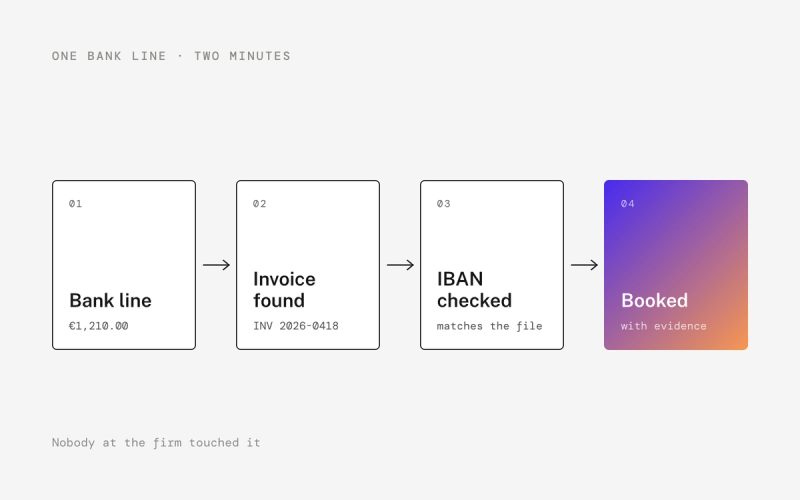
Bank and payment lines matched to invoices and receipts, coded to the right account and BTW rate, and booked. In most firms with a bookkeeping practice this is the bulk of the hours, and almost all of it passes the test. The answer is in the documents. It is also where an agent is most consistent, because the same transaction gets booked the same way every time.
Chasing documents
You know the ritual. A list of bank lines without receipts, an email to the client, a reminder, a message on WhatsApp, a phone call the week before the VAT deadline. An agent can scan each client's books for missing bills and receipts, request them by email or WhatsApp, and match what comes back to the right transaction. Nobody went into accounting to send the fourth reminder.
Period-end preparation
Accruals, depreciation and recurring corrections follow rules your firm already has. An agent can prepare and book them, so the books are ready before your accountant starts the actual closing work.
Checks across your client portfolio
Unreconciled items, unusual bookings, a client who is falling behind. Today someone on your team opens each administration and looks, and with 80 or 150 clients that rarely happens every week. An agent can run the same check across every client each day and report the few that need attention.
Routine client questions
"What did we pay that supplier this year?" "Has the March invoice been paid?" These are lookups. Your clients ask them by email, they interrupt your team's day, and they take longer to find than to answer.
Where does the answer have to be formed?
Run the same test the other way and a second list appears. These are tasks where every fact can be on the table and the answer still isn't there, because it lives somewhere a document can't reach.
- In the grey zones of the rules. Is a new roof a capital item or repairs? Is the freelancer who has billed 40 hours a week for a year an employee in all but name? Does a client's new webshop flow fall under OSS? The file holds the facts. Someone has to take a position on them.
- In proportion. A €300 difference on one client is noise, on another it is the first sign of a missing revenue stream. Deciding which differences are worth a client's money to chase is a weighing, not a lookup.
- In the trend nobody wrote down. Three quarters of slipping margin, an owner who hasn't mentioned it, and the sense that this is the week to call.
- In the client's future. Structuring, the timing of an investment, preparing a sale, a letter from the Belastingdienst. The inputs are in the books, but the answer depends on plans and appetite that only come out in a conversation.
- In a signature. When a registered accountant signs the annual accounts, the answer to "is this right?" is theirs to give.
Notice that agents still matter on this side. Every item on the list gets easier when your team starts from current books with the evidence already attached. An answer formed on stale data is a guess. An answer formed on current, traceable data is the work your people trained for, and the work clients will pay more for.
How does your firm's week change?
The biggest shift is not a task disappearing. It is your team moving from making entries to reviewing them.
In a keying model, your firm produces every booking and review happens afterwards, if there is time. In an agent model, the agents produce the bookings and your team reviews by exception. Say a client has 400 bank lines in a month. The ones the rules cover are booked. Your accountant sees the rest, like a transfer without an invoice, a supplier invoice above the approval limit or a new counterparty nobody recognises, each with its evidence.
That shift changes four things in practice.
- Your firm's rules become an asset. How your firm books (this client puts fuel on the vehicle account, that one splits rent across two entities) used to live in people's heads. Now it is written down once and applied every time. Firms that capture their rules well get better results from their agents.
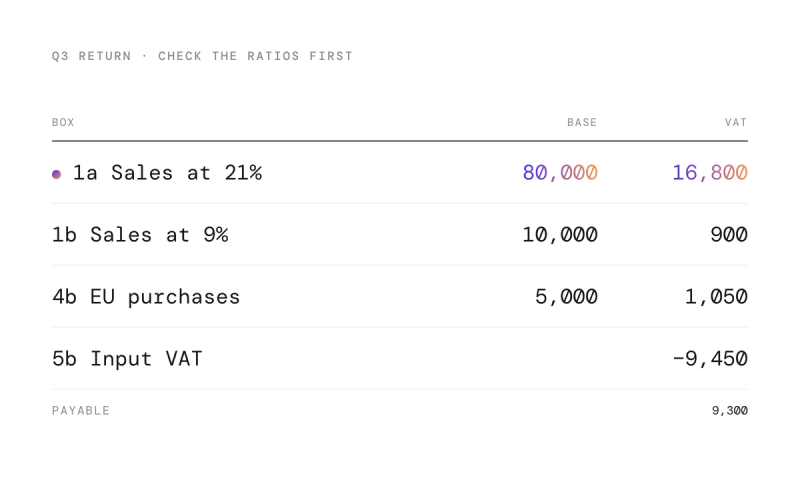
- Timing moves. When transactions are processed daily, there is no quarterly pile. The VAT return is prepared from books that are already correct, and the crunch before the deadline turns into a review.
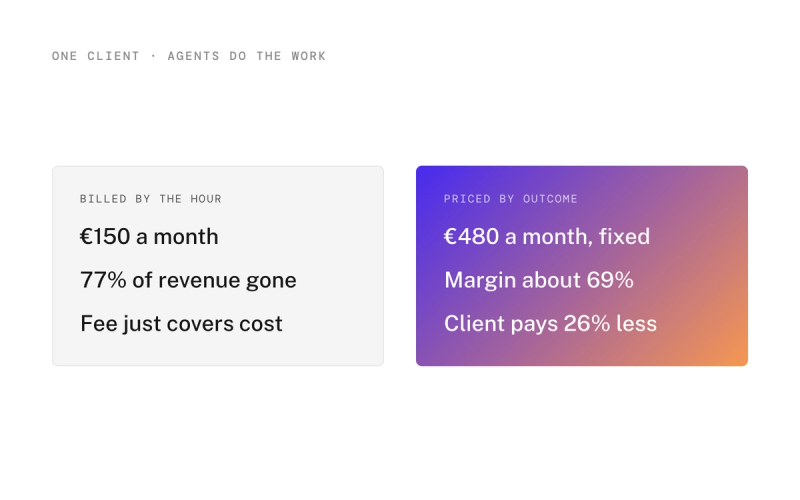
- Capacity frees up. The same team can look after more clients, or spend the hours on advisory and new business. Which one you choose is a strategic decision for the partners, not a technical one.
- The skills that matter shift. Reviewing well, spotting what's off and explaining it to a client. A junior who reviews agent work with the evidence beside it sees more cases in a month than one who keys invoices all day.
What should your firm be careful about?
None of this works by switching it on and walking away. A few things matter.
Bad rules make consistently bad books. An agent applies the rules it is given, every time. If a rule is wrong, it is wrong everywhere. Review the rules first, and keep agents asking before they act on anything with real risk until you trust them.
Set autonomy per task and per client. Matching a monthly software subscription can run on its own early. Approving supplier payments probably shouldn't. A good setup lets you decide this per agent and per client, and change it later.
Insist on a trail. For every entry you should see the source document, the rule, who or what booked it and who approved it. That is what makes review possible and the file defensible, and it is one of the commitments we hold ourselves to.
Don't make clients switch software. The fastest way to stall adoption is to ask your clients to change ledgers. Agents should work on Exact Online, Twinfield or whatever the client already uses, and push finished work back there. That is why Thred runs as a layer on the ledger a client already has, with two-way sync, rather than asking anyone to migrate.
Where does Thred fit?
We built Thred around this split. For accounting firms, that means one workspace across all your clients' administrations, on the accounting software they already use. Agents keep every client's books up to date, collect missing documents by email or WhatsApp, run checks across the whole client base and prepare period-end, so your team reviews instead of keying in. The firm's own rules live in memories the agents apply as they work, and anything that needs a person lands in one inbox.
Answers that can be found go to the agents. Answers that have to be formed stay with your team, on better data than you had before.
More on what this looks like across a client portfolio is on our page for accounting firms.
Frequently asked questions
Will AI replace accountants?
AI is replacing parts of the work, not the profession. Tasks with an answer in the documents, like reconciliation and document chasing, are moving to software. Professional judgement, client advice and signing off accounts remain with qualified people.
Which accounting tasks can AI automate today?
Matching bank and payment lines to invoices, coding them to accounts and VAT rates, requesting missing receipts, booking recurring accruals and depreciation, and running checks across many client administrations. In each case the answer can be found in documents and rules the firm already has.
How do accountants review work done by AI agents?
By exception. The agent books what its rules cover and sends the remaining items, each with the source document and its reasoning, to a review queue. The accountant decides those and can turn recurring decisions into new rules.
How does AI affect an accounting firm's capacity?
When processing moves to agents, the same team can serve more clients or spend more hours on advisory and new business. Which of the two a firm chooses is a strategic decision for the partners.
What should a firm check before using AI on client books?
Check that the firm's booking rules are correct, that autonomy can be set per task and per client, that every entry carries a full audit trail, and that clients can keep their current accounting software.
Sources
Read next
- Will AI replace accountants? An honest answer for accounting firm owners
- AI for accounting firms: agents on the books of every client
- AI for bookkeeping firms: the work agents already do in your clients' books
Where Thred comes in
Make your firm more efficient with AI, so you have more time for relationships, new customers and advisory work.