Will AI replace accountants? An honest answer for accounting firm owners
AI will not replace accountants. It will replace a large part of the processing work firms bill for today. What that means for your team, your pricing and your growth.

Mark Holleman5 min read

Working on this yourself? Talk to Mark, our co-founder. We’re here to solve it with you.
On this page
AI will not replace accountants, but it will replace much of the work accounting firms currently bill for. Bank processing, invoice entry, reconciliation and routine period-end adjustments are moving to software agents. Judgement, sign-off, advice and the client relationship stay with people, and they become a larger share of what a firm sells.
If you own or run an accounting firm, the interesting question is not whether your profession survives. It is what your firm looks like when the processing hours that fill most of your team's week shrink sharply, and whether that is a threat or the best growth opportunity you have had in years. The easiest way to see it is in your own capacity numbers.
How does firm capacity change when agents do the processing?
Start with where the hours go today. In a typical small-business portfolio, most of them are spent on work that repeats every month, follows rules and can be checked against a bank line or a document:
- Booking bank lines and matching them to invoices
- Capturing supplier invoices and receipts, coding them and checking VAT
- Chasing clients for missing documents
- Reconciling payment platform payouts to sales
- Preparing recurring adjustments such as depreciation, prepayments and accruals
- Running the same checks over every administration, such as unreconciled items or unusual bookings
That is the work agents now do well. It does not disappear from the books. It disappears from your team's timesheets, while every entry stays traceable and a person reviews what needs reviewing.
Here is an illustrative example. A firm with 4 bookkeepers serves 120 small-business clients, 30 each. Each client takes about 6 hours of processing a month, so each bookkeeper spends 180 hours a month on processing and has no time for anything else.
Now suppose agents do the processing and each client needs about 2 hours a month of review, exceptions and client contact. The same 180 hours per bookkeeper could be split like this:
- 60 clients at 2 hours each, which is 120 hours
- 60 hours left for advisory work, onboarding and quality checks
With 4 people, that is 240 clients instead of 120, plus 240 hours of advisory capacity a month across the team. The hours are illustrative and every firm's mix is different, but the shape is consistent. Processing capacity stops being what limits your growth.
What does a day look like for your team?
Picture a bookkeeper in your firm on a Monday morning. Today she opens 30 administrations one by one, downloads bank files, books what she can and writes a list of questions for clients.
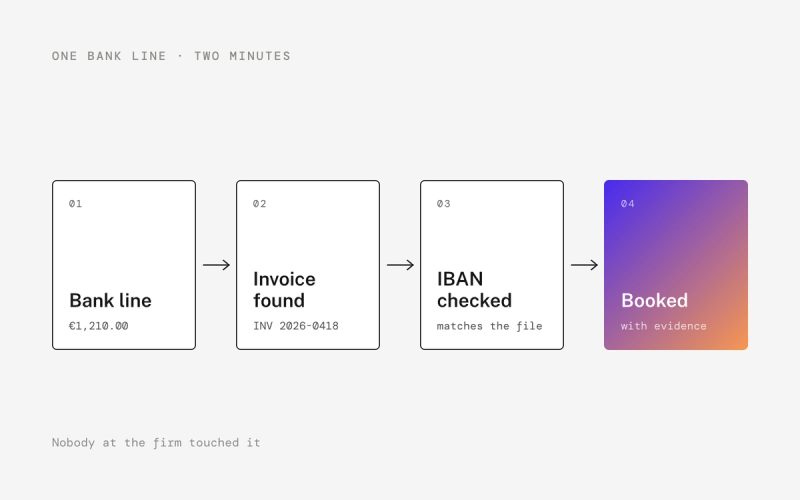
With agents doing the processing, her Monday starts with a single queue. Overnight the agents booked and matched the weekend's bank lines across all her clients. What is left are the items that need a person. A payment nobody can place, an invoice with an unexpected VAT rate, a client who has not sent three receipts before the VAT deadline. She works through the queue, approves the period-end entries the agents prepared, and spends the afternoon on two client calls she never had time for before.
By Thursday the work in front of her is the part with your firm's name on it. A client restructuring that changes how a provision is booked. A tax position she has to choose and may have to defend to the Belastingdienst or HMRC. A conversation about whether the client can afford a second hire. And the annual accounts: in the Netherlands, a compilation report or a statutory audit opinion comes from a qualified accountant, and in the UK a statutory audit is signed by a registered auditor. Agents prepare the file. They do not put their name under it, and clients do not hire a firm for its software. They hire the people in it.
That is the real change. Less typing, more deciding, and much more time with clients.
What should firm owners change now?
Rethink pricing before clients ask
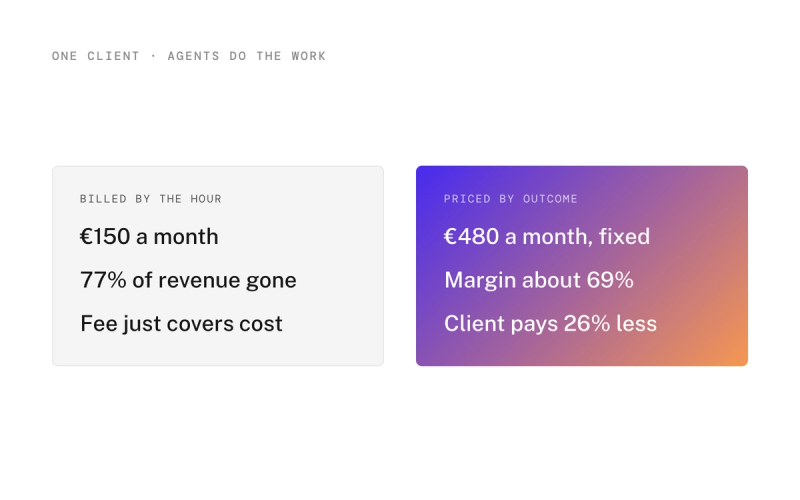
If you bill by the hour for processing, faster processing reduces revenue. Clients will notice that their books are current every day and start asking why the fee stayed the same. Move routine work to fixed monthly fees tied to outcomes, such as current books, a filed VAT return and a monthly report, and price advisory separately.
Change what juniors learn
The traditional apprenticeship, years of entering invoices before you are trusted with judgement, does not survive this shift. Train juniors as reviewers from day one. They learn by checking agent work, investigating exceptions and explaining the result to clients. That is a faster route to understanding a business than typing in its invoices.
Standardise across your portfolio
Agents work best when rules are explicit. Firms that use a consistent chart of accounts, consistent VAT treatment and written client rules get far more out of automation than firms where every client is set up differently. Standardisation used to be a nice-to-have. It is now the multiplier.
Look across clients, not into them one by one
The biggest change is that you can run the same check over every administration every day. Which clients have unreconciled items older than two weeks? Which ones booked an unusual amount to a suspense account? Who is behind on documents before the VAT deadline? You stop discovering problems when you open a file and start seeing them across the portfolio.
Which firms are most exposed?
The exposure follows the billing model. A firm whose revenue is mostly hours of processing, billed by the hour, sees that revenue shrink as the work speeds up, and its clients can increasingly buy processing straight from software. A firm that sells outcomes and advice, and knows its clients well enough to tell them what to do next, gains capacity from the same change.
Most firms we talk to are in a third position. They want to grow, cannot hire fast enough and turn clients away. For them, agents are a way to take on that work with the team they already have, with people moving from keying to reviewing and advising.
How should you evaluate tools for your firm?
A few questions are worth asking any provider:
- Does it work in my clients' existing ledgers, such as Exact Online, Twinfield or Xero, or does it require a migration?
- Can my team see every entry with its source document, and who or what booked it?
- Can I set rules per client and also apply standard rules across the firm?
- Can I run checks across my whole client base from one place?
- Where is client data stored, and is it ever used to train models?
Where does Thred fit?
Thred gives accounting firms one workspace across all client administrations. Agents keep each client's books current, collect missing documents and prepare period-end work, while your team reviews instead of keying in. Clients keep the accounting software they know, because Thred Layer works on top of it in two-way sync, and you can offer clients with in-house finance their own Thred workspace at a price you set. See how it works on Thred for accounting firms.
If you want to serve more clients with the team you have, book a demo.
Frequently asked questions
Which parts of a bookkeeping portfolio can agents take over?
The work that repeats, follows rules and can be checked against a bank line or document: booking and matching bank lines, capturing and coding invoices, reconciling payouts, chasing missing documents and preparing recurring adjustments such as depreciation. A person still reviews exceptions and approves what matters.
Can AI sign off annual accounts or an audit?
No. Compilation reports, audit opinions and the professional responsibility behind them stay with qualified accountants and registered auditors. Software can prepare the work, not take accountability for it.
How should accounting firms price work when AI does the processing?
Many firms move routine bookkeeping to fixed monthly fees tied to outcomes, such as current books and filed returns, and price advisory separately. Hourly billing for processing loses revenue as the work gets faster.
Which accounting firms are most exposed to AI?
Firms whose revenue is mainly processing billed by the hour, because that revenue shrinks as the work speeds up and clients can buy processing from software directly. Firms that sell outcomes and advice gain capacity from the same change and can take on more clients with the same team.
What should a firm look for in AI accounting software?
Support for clients' existing ledgers, full traceability of every entry, client-specific and firm-wide rules, checks across the whole portfolio and clear commitments on where client data is stored.
Sources
Read next
- AI for accounting firms: agents on the books of every client
- AI in accountancy: what works today in a compilation practice
- AI for bookkeeping firms: the work agents already do in your clients' books
Where Thred comes in
Make your firm more efficient with AI, so you have more time for relationships, new customers and advisory work.