How to grow your accounting firm without hiring more staff
Your firm's capacity is set by processing hours per client, not by headcount. Cut those hours and the same team can serve far more clients, or sell more advice.

Mark Holleman5 min read

Working on this yourself? Talk to Mark, our co-founder. We’re here to solve it with you.
On this page
An accounting firm grows without hiring by lowering the number of processing hours each client costs, so the same team can carry more clients or spend more time on advisory work. Working harder or faster does not get you there. Taking routine processing out of your team's week does.
If you run or co-own a firm, you know the shape of the problem. Demand is there. New clients ask to join, existing clients want more help. But every new administration adds hours of bank coding, document chasing and VAT preparation, and finding good people to absorb those hours takes months. So you turn work away, or you say yes and the team works every evening in the weeks before the quarterly VAT deadline.
Where do the hours in your practice actually go?
Before you change anything, measure it. Pick ten typical clients and, for one month, have the team note roughly where the time goes per client. Most firms find the hours fall into four buckets:
- Processing. Coding bank lines, booking purchase and sales invoices, matching payments, correcting earlier bookings.
- Chasing. Emails and calls to get receipts, invoices and explanations from the client.
- Review. Checking the books, preparing the VAT return, period-end adjustments, the annual accounts file.
- Client contact. Answering questions, discussing results, advising.
The first two buckets grow with transaction volume. The last two grow with the value you deliver. Most firms are surprised by how much of the month sits in the first two, and how little in the last.
Why doesn't hiring solve it?
Hiring adds hours, but it does not change the ratio. A new assistant spends most of their week in the same processing and chasing buckets, because that is where the work is. Your capacity rises in a straight line with headcount, and so does your cost base.
Hiring also has a lag. A new person needs time to learn your clients, your ledger setups and your house rules before they are fully productive, and the busy periods around VAT returns and annual accounts do not wait for that. The Netherlands requires most businesses to file VAT returns, usually per quarter, and each deadline lands on every client at once. More people help with that peak only if you hire for the peak and carry the cost all year.
The alternative is to take hours out of each client.
What does the capacity math look like?
Here is an illustrative example for a small firm. The numbers are rounded for clarity, so use your own measurements.
- The team is four people with 140 client hours each per month, so 560 client hours in total.
- An average client takes 7.0 hours a month: 4.5 on processing, 1.0 on chasing, 1.0 on review and 0.5 on client contact.
- 560 hours divided by 7.0 hours per client means the firm can carry 80 clients.
Now suppose processing and chasing are mostly handled by agents, and the team reinvests part of the time in better review and more client contact:
- Processing drops to 1.0 hour, chasing to 0.5, review rises to 1.5 and client contact to 1.0.
- That is 4.0 hours per client.
- 560 hours divided by 4.0 hours per client means the same team can carry 140 clients.
Notice what did not happen. Nobody works faster. The team actually spends more time per client on review and contact than before. The gain comes entirely from removing work that never needed an accountant in the first place.
You can also spend the freed hours differently. Keep 80 clients and use 240 hours a month for advisory work, forecasting or year-end planning. Most firms end up somewhere in between.
Which work should you take out first?
Start where the volume is highest and the judgement is lowest. For most firms that order is:
- Bank reconciliation and booking. Every line can be checked against evidence, which makes it the safest place to start and the easiest to review.
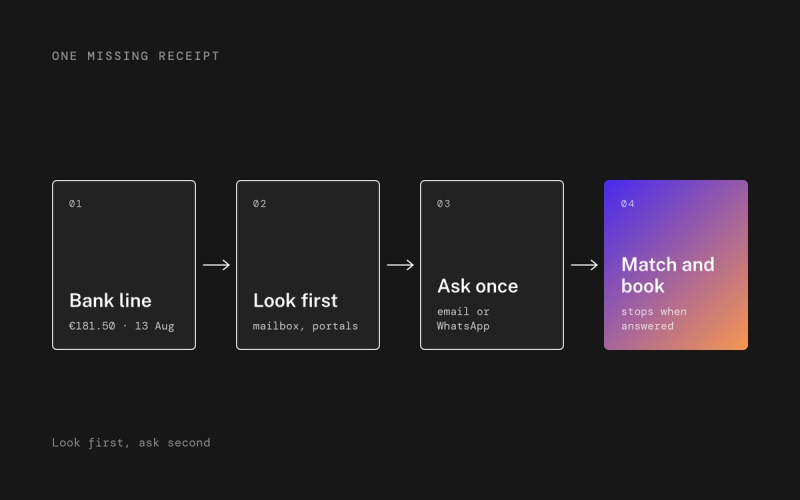
- Missing documents. Agents can check each client's books for transactions without a receipt or invoice and request them directly from the client by email or WhatsApp, so your team stops writing reminder emails.
- Checks across all clients. Instead of opening each administration, run one check across your whole client base for unreconciled items, unusual bookings or clients falling behind.
- Period-end preparation. Recurring accruals, depreciation and corrections booked before you start the review, so the books are ready before you file in your own tools.
This is the work Thred is built to do for firms. Agents process and reconcile transactions across your client base every day, in the ledgers your clients already use, and your team works from one place across all administrations. Our page for accounting firms shows how that workspace is set up.
What should stay with your team?
Taking processing out of the team's week only works if everyone agrees where the line is. A sensible default:
- Agents book what follows a rule your team wrote or approved.
- Anything new, unusual or above an amount you set comes to a person.
- VAT returns, annual accounts and tax filings are reviewed and signed by your people, in your own tools.
- Client advice and anything with a professional opinion attached stays human.
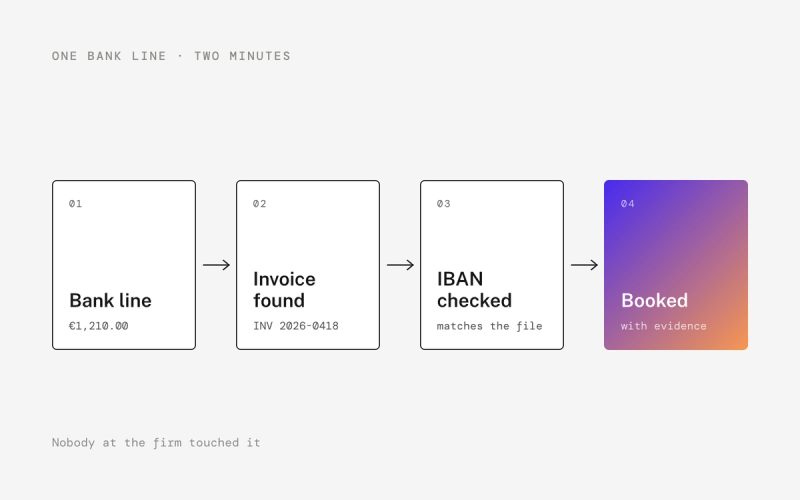
Every booking an agent makes should show the document, the bank line and the rule it applied, so a reviewer can check it in seconds rather than reconstruct it. If you are weighing how a tool handles client data and permissions, our security page describes the controls Thred uses.
How do you turn capacity into revenue?
Freed hours only matter if you use them. There are three common ways.
- Take on more clients at the same fee level. The most direct route, and the one the capacity math above describes.
- Sell advisory work. Monthly reporting, cash flow forecasts and planning conversations are easier to sell when the books are current every day instead of once a quarter.
- Offer a workspace to clients with in-house finance. Some clients have a finance person of their own. With Thred they can get their own workspace on the same ledger your firm works in, with chat, reports and agents for their own processes, and you bill it at a price you set.
The last option is worth a closer look, because it turns a cost of serving the client into a new revenue line from clients you already have.
How do you start without disrupting the practice?
Change in a firm stalls when it arrives as a big project. Keep it small and measurable.
- Pick ten clients with typical volumes, ideally on the same ledger.
- Measure hours per client for one month before you change anything.
- Turn on reconciliation and document collection for those ten, with the agents asking before they book.
- Review what the agents did weekly and turn repeated corrections into rules.
- Measure again after two months and compare hours per client.
If the hours per client fall, roll out to the next group. If they do not, you have learned where the remaining time sits, which is useful on its own.
The real constraint was never headcount
For most firms, the ceiling on growth is the number of hours each client consumes, and most of those hours are processing. Lower that number and your team becomes the thing that sets you apart: the people who know the clients, review the numbers and give the advice.
If you want to grow the practice with the team you have, see how Thred works for accounting firms, or book a demo.
Frequently asked questions
How many clients can one accountant handle?
It depends on client size, transaction volume and how much processing is automated. The useful number is hours per client per month: divide your team's client hours by it to get your capacity. Lowering that number is what raises capacity.
What is the fastest way to increase capacity in an accounting practice?
Remove processing work that does not need an accountant, starting with bank reconciliation and missing-document requests. These grow with transaction volume, so they consume the most hours as the client base grows.
Does automation reduce the quality of client service?
It should do the opposite. When processing time falls, the team can spend more time on review and client contact, and books are current more often, which makes advice more timely.
How should an accounting firm pilot automation?
Pick about ten typical clients, measure hours per client for a month, switch on one or two agents that ask before booking, review weekly and measure again after two months. Roll out further only if hours per client fall.
Can accounting firms earn new revenue from automation?
Yes. Freed hours can go to advisory work such as forecasts and planning, and some firms offer clients with in-house finance their own workspace on the same ledger, billed at a price the firm sets.