How accounting firms can collect client documents without the chase
The quarterly list of missing receipts is why your team chases clients. Ask for one document at a time, when the transaction appears, and most of the chasing disappears.

Mark Holleman5 min read

Working on this yourself? Talk to Mark, our co-founder. We’re here to solve it with you.
On this page
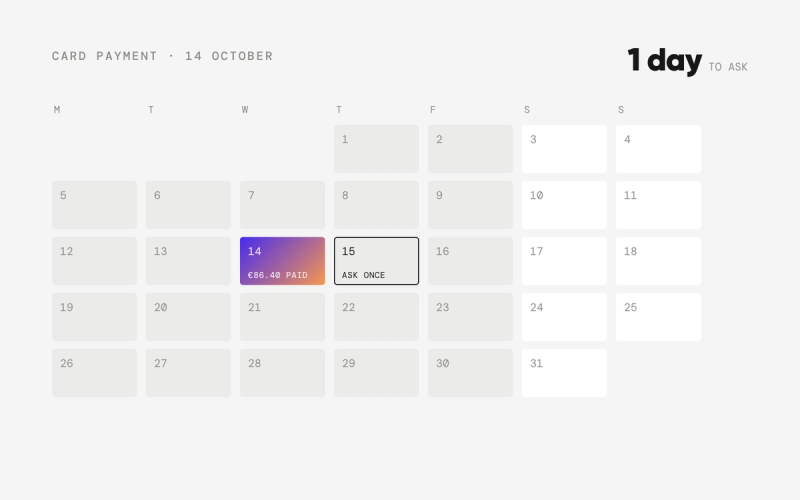
The way to stop chasing clients for documents is to ask for each missing receipt or invoice at the moment the transaction appears, with the amount, date and counterparty in the request, in the channel the client already uses. One small question the day after a purchase gets answered. A list of forty questions three months later does not.
If you run an accounting firm, you know how much of your team's week goes into this. Somebody exports the unmatched bank lines, builds a list per client, sends it by email, waits, sends it again, and finally calls. Then the VAT deadline arrives and half the list is still open.
Why does the quarterly list fail?
The list feels efficient because it bundles everything into one request. For the client it is the opposite.
- Memory has faded. A card payment of €181.50 from ten weeks ago means nothing without context. The client has to search their email, their phone and their car.
- The effort is front-loaded. Forty items look like an afternoon of work, so the list waits for a quiet afternoon that never comes.
- It arrives at the worst time. The list goes out when your firm is busy, which is right before a deadline, when the client is often busy too.
- There is no clear finish. After answering twelve items, the client does not know whether the rest matters.
The result is predictable. Your team spends hours on follow-ups, items get booked to a suspense account, and the books are only complete after the deadline has passed.
What makes a document request easy to answer?
Think about the request from the client's side. They will answer quickly if it takes less than a minute and they know exactly what you need. That means each request should:
- Be about one transaction. One amount, one date, one counterparty.
- Arrive within a day or two of the transaction, while the client still remembers it.
- Say what kind of answer works. A photo of the receipt, a forwarded email, or a one-line explanation if there is no document.
- Use the client's channel. Some clients live in email. Others answer a WhatsApp message in seconds and ignore email for weeks.
- Stop when it is answered. No reminder for an item that has already been resolved.
A good request reads like something a colleague would send: "There is a payment of €181.50 to a hardware store on 13 August. Could you send the receipt, or tell me what it was for?"
How does continuous document collection work?
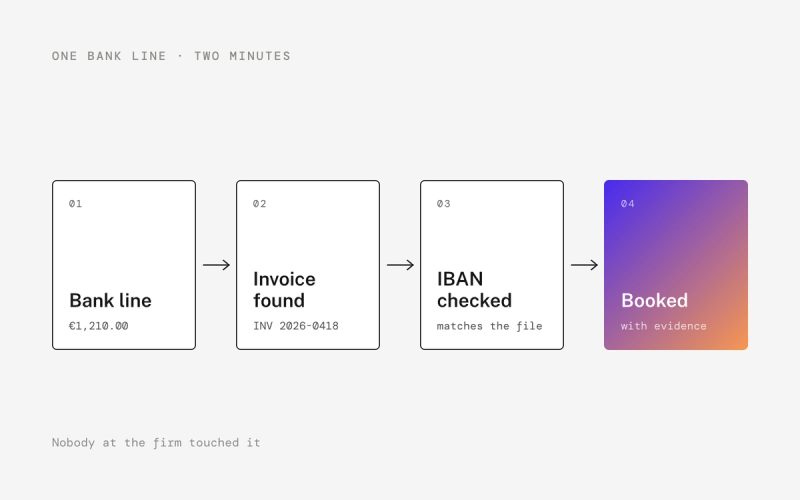
Continuous collection replaces the list with a small loop that runs every time new transactions arrive. For each client, it looks like this:
- A new bank line comes in.
- Look for the document first. Many documents already exist somewhere: in the client's mailbox, in an upload folder, in a supplier portal. Only ask when the search finds nothing.
- Ask the client one specific question, by email or WhatsApp.
- Match the answer to the transaction and book it.
- Remind once or twice at sensible intervals if there is no answer.
- Escalate to your team only when the reminders have not worked or the answer raises a question that needs a person.
The important step is the second one. Asking a client for an invoice that is already sitting in their inbox wastes their goodwill. Look first, ask second.
This is the loop Thred's agents run for firms. They scan each client's books for missing bills and receipts, request them by email or WhatsApp, and match what comes back to the right transaction, across your whole client base. Your team only sees the cases that are stuck. Our page for accounting firms shows how this fits into one workspace across all your clients.
What rules should you set per client?
Clients are different, and one policy for all of them creates friction. Agree a few settings per client and write them down.
- A threshold. Below a certain amount, some clients may prefer a one-line explanation to a receipt. Decide with each client, and make sure the policy still meets what your firm needs for VAT and income tax purposes.
- Who to ask. In a small company the owner pays for most things, but the office manager may hold the supplier invoices. Ask the person who actually has the document.
- The channel and language. Email, WhatsApp, Dutch or English.
- The rhythm. Daily for busy webshops, weekly for a consultant with ten transactions a month.
- Known recurring suppliers. Subscriptions and utilities that send invoices to a mailbox should never trigger a question.
What counts as a valid document?
Collecting a document is only useful if it does the job. For a purchase invoice to support a VAT deduction in the Netherlands, it generally needs details such as the supplier's name and VAT identification number, an invoice number and date, a description of what was supplied, and the amounts and VAT rate. The full list is on business.gov.nl, and special cases such as reverse-charge purchases have their own rules.
Two practical points follow from this:
- A payment confirmation is not an invoice. A card slip or a bank screenshot shows that money left the account, not what was bought or how much VAT was charged.
- Keep what you collect. Dutch businesses must generally keep their records for seven years, and longer for some items such as real estate. A collected document should be stored with the transaction it belongs to, so nobody has to find it again later.
What happens when no document will come?
Sometimes there is no receipt. The parking meter did not print one, or the supplier has gone quiet. Decide in advance what happens next, so these items do not sit open forever:
- Ask the client for a short written explanation and attach it to the booking.
- Flag the item for your team to decide how it should be treated, including whether VAT can be deducted.
- Close the request so it stops appearing in reminders.
An item with a clear decision and a note is far better than one that is still "waiting for client" at year-end.
What changes for your firm?
When documents arrive continuously, three things change. The books are closer to complete at any moment, so VAT preparation becomes review instead of reconstruction. Your team stops writing reminder emails, which is some of the least satisfying work in any practice. And your clients notice that you ask fewer, simpler questions, which makes you easier to work with.
It also changes your capacity. The hours your team used to spend chasing can go to more clients or to advisory work. We wrote about that trade-off in more detail in our piece on growing a firm without hiring more staff. If your clients use Exact Online, Xero or Moneybird, Thred's agents work on top of those ledgers, as described on Thred Layer page, so nothing about your clients' setup has to change.
If chasing documents eats your team's week, see how Thred works for accounting firms, or book a demo.
Frequently asked questions
How do you get clients to send receipts on time?
Ask for one receipt at a time, within a day or two of the purchase, and say exactly which payment you mean. Small, specific requests in the client's own channel get answered far faster than a long list sent before a deadline.
Is a bank statement enough instead of an invoice?
Usually not for VAT purposes. A bank line or card slip shows a payment, not what was bought or how much VAT was charged, so a proper invoice is generally needed to deduct VAT.
How long must Dutch businesses keep receipts and invoices?
Generally seven years, and ten years for data related to real estate and for some VAT schemes. Records can be kept digitally as long as they remain complete and accessible.
What should a firm do when a client cannot provide a receipt?
Ask for a short written explanation, attach it to the booking and have someone in the firm decide how it is treated, including whether VAT can be deducted. Then close the request so it does not linger until year-end.
Can document collection be automated?
Yes. Software can check each client's transactions for missing documents, search the mailbox and upload folders first, send a specific request, match the reply and remind if needed, escalating to the firm only when stuck.