Chasing missing receipts without nagging: a better system for documents
Most missing receipts are a system problem, not a people problem. How to ask once, at the right moment, in the right channel, and find the rest yourself.
David van Duijn6 min read

Working on this yourself? Talk to Mark, our co-founder. We’re here to solve it with you.
On this page
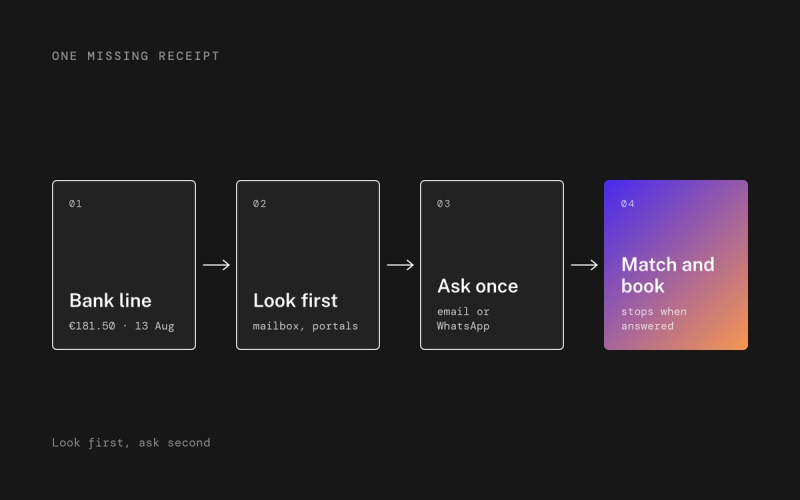
The best way to chase missing receipts is to need fewer chases. Find every document you can without asking anyone, ask for the rest once, right after the payment and in the channel people already use, and make replying take less than ten seconds. Nagging is what happens when the system starts too late.
If you are a finance lead or controller in a growing company, you know the month-end version of this. Forty card payments without a receipt, a spreadsheet with names next to them, a group email that nobody answers, and a second email with "friendly reminder" in the subject line that is not friendly at all. By the third round you are guessing which receipts will never come, and your colleagues have started to avoid you in the kitchen.
Why do receipts go missing in the first place?
Almost never because people refuse to hand them over. Receipts go missing because of timing and friction.
- The request arrives weeks after the purchase, when nobody remembers what "AMZN Mktp 86.40" was.
- The receipt exists, but in someone's personal inbox, a supplier portal or a WhatsApp photo, not where finance can see it.
- The request asks people to do work: log into a tool, find the transaction, upload a file, choose a category.
- Requests are bundled into one long list per person, which looks like homework and gets postponed.
Each of these is a design problem. None is solved by sending the same email again with more exclamation marks.
Why does a missing receipt matter at all?
Because it costs money and creates risk, even when the amount is small.
In the Netherlands, you can generally only deduct input VAT when you have an invoice that meets the invoice requirements. A €121.00 purchase without a valid invoice can mean €21.00 of VAT you cannot reclaim. Across a year of card spend, that adds up. You also have to keep your administration, including purchase records, for seven years, as the Belastingdienst explains. In the UK, HMRC asks limited companies to keep records for six years from the end of the financial year they relate to, and VAT-registered businesses generally need a valid VAT invoice to reclaim input VAT. Your accountant will tell you which documents count for your situation.
There is also the cost you do not see on a VAT return. Every open transaction is a booking someone has to look at again. A close that waits for receipts is a close that finishes late.
Step 1. What can you find without asking anyone?
Before a single request goes out, look for the document yourself. A surprising share of missing receipts are not missing at all.
- Many software and online suppliers email an invoice to whoever signed up. Search the company's shared and finance inboxes for the merchant name and amount.
- Subscriptions often have a billing page with every invoice ready to download. Recurring vendors are worth setting up once to send invoices to a dedicated address.
- Travel and marketplace purchases usually have an order history with a downloadable invoice.
- A forwarding address for documents, one per company, lets suppliers and colleagues send invoices straight to the books instead of to a person.
Do this first, every time. Each receipt you find yourself is one less request, and the requests you do send carry more weight because there are fewer of them.
Step 2. How do you ask so people actually reply?
Ask once, ask early, and ask in a way that answers itself.
Ask at the moment of the payment
The best time to ask for a receipt is within a day of the card payment, while the person still has it in their bag or inbox. A request sent the next morning gets a photo. The same request sent five weeks later gets a shrug.
Ask in the channel people already use
If your team lives in Slack, ask in Slack. If the founder answers WhatsApp in thirty seconds and email in three days, ask on WhatsApp. Finance does not get to choose the channel; the person who holds the receipt does.
Give all the context in the request
A good request carries the date, the amount, the merchant as it appears on the statement and the card or account used. "Can you send the receipt for €86.40 at the office supplies store on 14 October, paid with your company card?" can be answered without opening anything.
Make the reply the upload
The ideal reply is a photo or a forwarded email in the same thread. No login, no form, no choosing a category. If finance needs more information, such as the business purpose of a dinner, ask one short question in the same message.
Step 3. Which receipts are worth chasing?
Not every missing document deserves the same effort. Agree a simple order of priority with your accountant and stick to it.
- Purchases with deductible VAT and larger amounts come first, because they carry real money.
- Recurring vendors come next, because fixing the source once fixes every future month.
- Small amounts with little VAT at stake can often be handled with a short internal note instead of a long chase, if your accountant agrees.
Write the threshold down. When you decide in advance that a €4.50 coffee does not get three reminders, nobody has to make that call at 6 pm on the last working day.
Step 4. How do you follow up without nagging?
Sometimes a first request is not enough. A good follow-up is short, specific and spaced out.
- Follow up once, a few days later, in the same thread, so the context is still there.
- Batch any remaining items into one short weekly digest per person, not a daily stream.
- After the second request, stop chasing and decide. Either the document can be retrieved another way, or the transaction is booked without VAT deduction and noted for your accountant.
Most of the frustration around receipts comes from requests that never end. A clear end point is kinder to your colleagues and better for your close.
Step 5. How do you close the loop?
When a receipt arrives, match it to the bank line, book it and say thank you, ideally in one go. People who see that their photo was used are faster the next time.
Track two numbers each month: the share of card and bank payments with a document attached, and how many requests it took to get there. If coverage stays high and requests go down, the system is working. If requests go up, look at which vendors or cards keep coming back and fix them at the source.
What changes when an agent runs this system?
Every step above is easy to describe and tedious to do every day. That is where an agent changes the work.
- It checks each new bank and card line against the documents it already has, within minutes of the bank sync.
- It searches connected inboxes and supplier emails before anyone is asked.
- It sends one request with full context to the right person, follows up once, and stops at the threshold you set.
- It matches the reply to the bank line and books it, and keeps a live count of coverage instead of a month-end list.
The controller no longer runs the chase. They see the handful of documents that truly need a decision.
What does this look like for accounting firms?
Firms face the same problem at a larger scale, across dozens or hundreds of clients. The principles do not change: look in the client's connected inboxes first, ask the client once, in their channel, with full context, and stop chasing at a clear point. The difference is that a firm needs one view across every client to see who is falling behind, instead of one spreadsheet per administration. This is how Thred for accounting firms approaches it: agents scan each client's books for missing bills and receipts and request them by email or WhatsApp.
How Thred handles missing documents
This system is mostly mechanical, which is why it suits agents. In Thred Layer, the bookkeeping agent checks each bank line as it syncs, searches your connected email accounts for the matching document, and only asks a person when it cannot find one. The request goes to the right person in Slack, WhatsApp or email, with the payment details included. The reply is matched and booked, and anything that still needs a decision lands in your inbox, with a forwarding address per company for suppliers to send invoices to directly.
For a finance lead, that means month-end starts with the documents already in place. For a founder, it means fewer messages from finance and a reply that takes one photo. See how it fits growing businesses.
Want to stop chasing receipts by hand? Book a demo.
Frequently asked questions
Can I deduct VAT without a receipt?
In the Netherlands you generally need an invoice that meets the legal invoice requirements to deduct input VAT. Without it, the VAT on that purchase may not be reclaimable. Ask your accountant how to handle specific cases.
How long do I need to keep receipts in the Netherlands?
The Belastingdienst requires businesses to keep their administration for seven years, with longer periods for some records such as real estate. Purchase invoices and receipts are part of that administration.
When is the best time to ask for a missing receipt?
Within a day of the payment. The person still remembers the purchase and usually still has the receipt, so a short request gets a quick photo reply.
How many reminders should I send for a missing receipt?
One follow-up in the same thread is usually enough. After that, retrieve the document another way or book the transaction without VAT deduction and note it for your accountant.
How do I measure whether receipt collection is working?
Track the share of payments with a document attached and the number of requests it took. Rising coverage with fewer requests means the system is working.
Sources
Read next
- Switching accounting software without losing your history: what to migrate, what to archive, and when not to switch
- How an agent learns your booking rules without you writing them
- Chasing unpaid invoices: email templates that work
Where Thred comes in
Finance agents running on top of your existing ledger. You set the rules, approve the work and handle the exceptions. No migration.