What rules cover in Exact Online, and what agents can take over
Exact Online's rules and built-in features handle the repeatable lines. Here is the work they leave behind, which of it agents can take over, and what stays with a person.

Manoj Tutika7 min read

Working on this yourself? Talk to Mark, our co-founder. We’re here to solve it with you.
On this page
In Exact Online, the built-in features automate bank imports, recurring bookings and invoice scanning, and agents working through the API can take over most of what is left: unmatched bank lines, invoice coding, VAT checks, missing documents and period-end entries. Filing and payments should stay with a person.
If you run finance in a growing company on Exact Online, as controller, finance lead or the founder who still does the books, you are probably not short of automation. You are short of the right kind.
Exact already does a lot on its own. Bank feeds bring in your transactions every day. Matching rules book the recurring lines. Scanned purchase invoices arrive with most fields filled in. The VAT return is built from the VAT codes on your entries. And there is a REST API for everything else.
Yet you or your team still spend Tuesdays clicking through unmatched bank lines, chasing colleagues for receipts and fixing VAT codes in the last week before the quarter closes. And the month-end close still starts with a backlog instead of a review. That is not because the software is bad. It is because the work that is left is the work that needs judgement, and rules do not do judgement.
At Thred we build agents that work on top of ledgers like Exact Online, so we spend a lot of time on the line between what can be handed over safely and what cannot. This is our honest map of it, written for the person who owns the close.
What does Exact Online automate on its own?
Before adding anything, use what you already pay for. A surprising number of administrations run with half of it switched off.
- Bank feeds. Direct connections to the major Dutch banks mean statements arrive daily, not when someone remembers to upload a file.
- Matching rules. For lines that look the same every month (rent, the lease car, your telecom provider) a rule books them without anyone looking.
- Invoice scanning. Purchase invoices sent to the scan address are read and pre-filled as a booking proposal.
- The VAT return. Because every entry carries a VAT code, the return is assembled from the journals. If the codes are right, the return is right.
- The API. Anything Exact does not do itself can be done by a connected application, within the permissions you grant it and the rate limits Exact sets.
If your monthly rent still gets booked by hand, fix that first. No agent is needed for work a rule can do.
Where does the manual work pile up?
The rules break at exactly the points where the business is interesting. Say you post 400 bank lines a month and the rules handle 300 of them. The remaining 100 are where all the time goes, and they look like this:
- A payment of €1,089.00 to a supplier you have used twice, with no invoice in the administration yet.
- One incoming payment that settles three sales invoices, minus a small discount nobody agreed in writing.
- A software subscription billed from Ireland, scanned with 21% Dutch VAT when it should have been reverse charged.
- A card payment at a restaurant with no receipt, no context and a cardholder who is on holiday.
- A Stripe or Mollie payout that bundles fifty orders, fees and a refund into one bank line.
None of these are hard for a person who knows the business. They are slow because each one needs a little context, often from someone outside finance. That is the work worth automating, and it is also the work a matching rule will never touch.
How do you decide what to hand over?
Before you hand a task to software, ask three questions.
- Can the right answer be checked? Matching a payment to an invoice can be verified against the amounts. Deciding whether a cost is deductible is an opinion.
- Is a mistake visible and reversible? A wrong booking in an open period can be corrected. A filed return or a sent payment cannot be pulled back so easily.
- Is the context available? If the answer lives in an email, a contract or the order system, an agent can find it. If it lives only in someone's head, it has to ask.
Tasks that pass all three can run on their own. Tasks that fail the second one should always end with a person approving.
Which work can agents take over in Exact Online?
Here is the work we would hand over first, roughly in the order it pays back.
1. The bank lines your rules leave behind
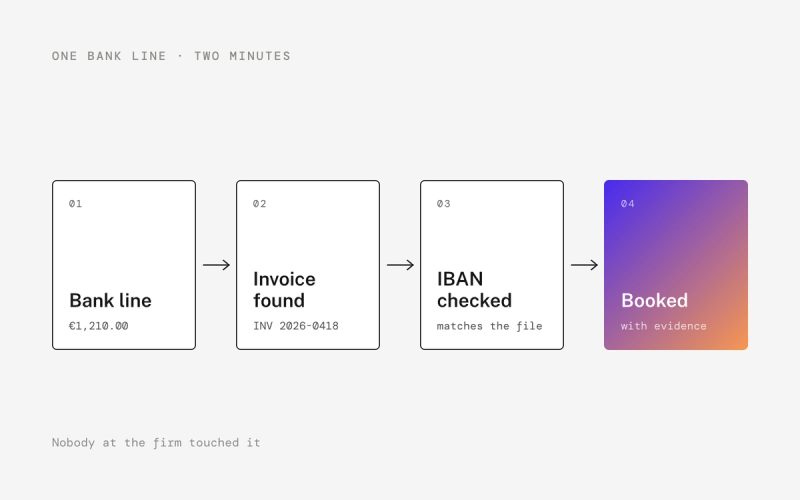
This is the biggest block of time in most administrations. An agent can look at an unmatched line the way a bookkeeper does: search for the open invoice, check the amount against partial payments and credit notes, look in the inbox for a document that never made it into Exact, and propose the booking.
Payment platform payouts belong here too. Splitting one payout into sales, fees and refunds is tedious for a person and very checkable for software, because the platform's own report says what is inside it.
2. Coding and checking purchase invoices
Scanning gets the fields off the page. It does not know that this supplier always goes to a specific cost account, that the invoice duplicates one booked last week, or that a foreign supplier means reverse charge. Those are exactly the checks an agent can run on every invoice, before it reaches the journal.
3. Chasing missing documents
An agent can spot every bank line without a document, ask the right person by email or WhatsApp, and attach the answer when it comes back. This one task often decides whether the books are current or two months behind.
4. Checks before the VAT return
Because the return is built from the codes on the entries, the real work is checking those codes before the quarter closes. Run the same checks on every entry, every week: foreign suppliers booked with Dutch VAT, sales to EU business customers without the right code, amounts that do not add up to 21% or 9%. A problem found in week two is a correction. A problem found after filing is a supplementary return to the Belastingdienst.
5. Period-end entries, prepared for approval
Accruals, depreciation and revenue recognition follow rules your accountant already agreed. An agent can prepare them every month with the reasoning attached, and a person approves. For accounting firms, the same checks can run across every client administration at once, so the ones falling behind surface on their own.
6. Questions about the numbers
"What did we spend on software this quarter, per vendor?" should not require an export to Excel. Once an agent can read the administration, questions like that are answered in a sentence, from live numbers.
What should stay with a person?
Being clear about this is what makes the rest safe.
- Filing. An agent can prepare the VAT return and explain every line. A person, or your accountant, submits it.
- Payments. Preparing a payment batch is automation. Releasing money is a decision.
- Judgement calls on tax and policy. Whether a cost is private, whether a contract is a lease, how to treat a one-off deal. The agent should ask, then remember the answer.
- Anything new. The first time a type of transaction appears, a person decides. The second time, the agent should already know.
How do you automate without losing control?
The worry we hear most is reasonable: "I do not want software writing into my books unsupervised." You do not have to allow that. A sensible setup looks like this.
- Read first. Start with read access only. Let the agent check, flag and propose for a few weeks, and compare its proposals with what your team would have done.
- Write with permission, per task. Then decide per task how much freedom it gets. Reconciling a payout might run on its own. Booking a new supplier's first invoice asks first.
- Keep Exact as the system of record. Your accountant should keep working where they always have. The finished entries land in Exact as normal entries, with the source document attached, so nothing about the audit trail changes.
- Make every step traceable. For every booking you should be able to see the document, the bank line, who or what booked it, and who approved it.
Ask any vendor how they handle access, hosting and logging before you connect them. We describe our own answers on the security page.
This is how we built Thred Layer. Thred keeps a copy of your ledger in two-way sync, the agents do the work there, and only finished entries are pushed back to Exact Online, within the limits you set. Each agent either asks first or runs autonomously, and you can change that at any time. Rules that are specific to your business are stored as memories, so the agent applies them the next time without asking again.
Where should you start?
Do not try to automate everything. Pick the task that costs your team the most hours and passes the three questions above. For almost everyone that is the unmatched bank lines plus the missing documents behind them.
Run it read-only for a month. Count how often the proposals were right. Then let it write, one task at a time.
The goal is not fewer clicks in Exact Online. It is books that are correct every day instead of at the end of the quarter, so your close becomes a review and the numbers you report are the numbers you actually have, without adding headcount to get there.
If that is the problem on your desk, Thred Layer is built for exactly this: agents on top of the Exact Online administration you already have, nothing to migrate. If you run an accounting firm with a portfolio of Exact clients, see how the same works across all your client administrations. Or book a demo and we will show it on an Exact Online administration.
Frequently asked questions
Can Exact Online reconcile bank transactions automatically?
Partly. Bank feeds import transactions daily and matching rules book lines that look the same every period, such as rent or a lease. Lines that need context, like partial payments, bundled payouts or payments without an invoice in the administration, still need a person or an agent that can look for the missing information.
Does Exact Online have an API for automation?
Yes. Exact Online offers a REST API that connected applications use to read and write data such as journals, invoices and bank entries. Access is granted per application and subject to the permissions you give it and the rate limits Exact sets.
Is it safe for a controller to let software write bookings into Exact Online?
It can be, if writing is limited and traceable. Start with read access, let the tool propose bookings for a few weeks, and only then allow it to write for specific tasks. Every entry should carry its source document and a record of who or what booked and approved it.
Can the VAT return in Exact Online be fully automated?
The return itself is assembled automatically from the VAT codes on posted entries, so its accuracy depends on those codes being right. Checking the codes on every entry can be automated, but submitting the return to the Belastingdienst should remain a decision made by a person or your accountant.
What should accounting firms automate first across client administrations?
Usually the unmatched bank lines and the missing documents behind them, because that is where most hours go. Running the same checks across every client administration also shows which clients are falling behind before period-end.