Bookkeeper, accountant, agent: who does what in a small company's finance in 2026
Small companies used to split finance between a bookkeeper and an accountant. Now there is a third worker. Here is a clear division of tasks, decisions and sign-offs.

Mark Holleman7 min read

Working on this yourself? Talk to Mark, our co-founder. We’re here to solve it with you.
On this page
In a small company in 2026, the agent does the repetitive transaction work, the bookkeeper owns the daily record and its exceptions, and the accountant owns the rules, the filings and the sign-off. Each one has a clear job, and the trouble starts when nobody has written down where one job ends and the next begins.
If you run a growing company, you have probably lived with a simple split for years. A bookkeeper, or you on a Sunday evening, entered the transactions. An accountant turned them into a VAT return and annual accounts once a quarter or once a year. A third worker has now joined that picture, and it changes what you, your bookkeeper and your accountant spend time on.
Why did the old split stop working?
The classic arrangement assumed that bookkeeping was mostly typing. Bank lines came in, a person coded them, receipts were stapled to a sheet or uploaded to a folder, and the accountant cleaned up whatever was left at the end of the year.
Three things have changed since then.
- Volume went up. A small webshop or agency now has payment providers, card payouts, subscriptions and marketplace fees, each producing dozens or hundreds of lines a month.
- You want current numbers. Waiting until the quarter is over to learn whether a month was profitable feels slow when every other system you run the company on is live.
- Software can now do the routine work itself. Not just suggest a ledger account, but match the bank line, find the invoice in the mailbox, book it and keep a record of why.
The result is that the old roles still exist, but the hours inside them have moved.
What does an agent actually do?
An agent is software that carries out a recurring task from start to finish within rules you set. It is different from a chat assistant, which answers when you ask. An agent works on its own schedule, for example every time the bank syncs, and only comes to a person when it needs a document, an explanation or a decision.
In finance, the tasks that suit agents share three traits. They repeat, they follow rules that can be written down, and each step can be checked against evidence such as a bank line, an invoice or a contract.
Typical agent work in a company like yours:
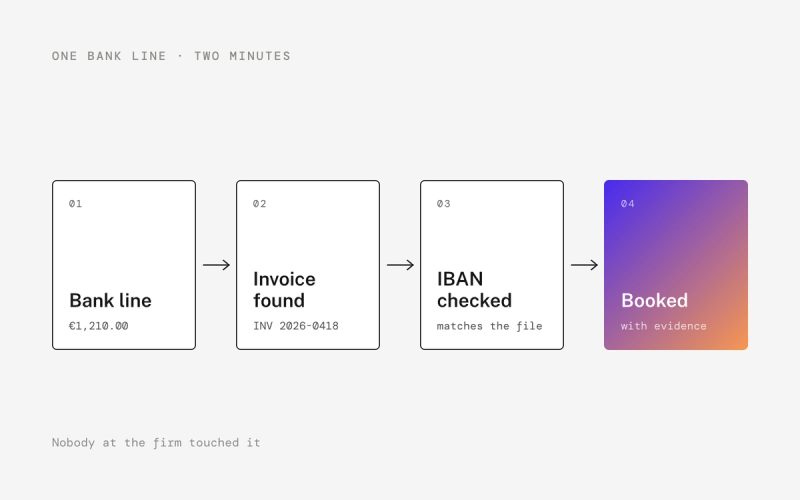
- Matching bank and payment lines to invoices and booking them
- Reading supplier invoices, checking the VAT and preparing them for approval
- Sending payment reminders on overdue sales invoices
- Booking recurring accruals and depreciation each month
- Asking the right person for a missing receipt, by email or chat
What does a bookkeeper do in 2026?
The bookkeeper stops being the person who types and becomes the person who owns the record. That is a better job, and it needs a different skill set.
In practice the bookkeeper:
- Handles the exceptions the agent cannot resolve, such as a payment with no clear counterparty or a mixed private and business purchase
- Decides how new types of transactions are booked, then writes that decision down as a rule the agent can follow next time
- Reviews a sample of what the agent booked, especially in the first months
- Keeps the client or owner informed about what is still open
A good bookkeeper in this setup works less on clearing a backlog of bank lines, and more on making sure the rules are right. If you are the founder who has been doing the bookkeeping yourself, this is the part you hand over first.
What does an accountant do that an agent should not?
The accountant's work is judgement with consequences. Choosing how revenue is recognised on a multi-year contract, deciding whether a cost can be capitalised, advising on the legal structure, signing off the annual accounts. These are decisions where someone must be accountable, and that someone should be a person.
In the Netherlands, "registeraccountant" (RA) and "accountant-administratieconsulent" (AA) are protected titles, and many small companies use one of them to compile their annual accounts and file their tax returns, even where no audit is required. Whether your company needs an audit depends on its size, so check with your accountant.
An agent can prepare almost everything the accountant needs: a reconciled ledger, a draft VAT return, a list of unusual bookings with the evidence attached. What it should not do is make the final call on a position that the Belastingdienst may later question.
Who does what, task by task?
The clearest way to set this up is a short list of tasks with one owner each. The owner does the work or approves it. Everyone else may contribute, but there is no doubt about who is responsible.
A few principles keep the grid honest:
- The agent owns volume, never the policy. It books the hundredth software subscription the same way as the first, because a person decided how the first was booked.
- The bookkeeper owns the exceptions and the rules. Every exception resolved by hand should end with the question "should this become a rule?"
- The accountant owns anything filed or signed. VAT returns, annual accounts and corporate income tax returns get a human sign-off, every time.
- Payments leave the bank only with a person's approval. An agent can prepare a payment batch. Releasing it is a human act.
How does this work in a normal month?
Here is an illustrative month for a small services company with one part-time bookkeeper and an external accountant.
- 180 bank and payment lines come in during the month.
- The agent matches and books 162 of them on its own, because they match an invoice, a recurring supplier or a written rule.
- 14 lines need a document or a short explanation. The agent asks the owner or the supplier directly, and books each line once the answer arrives.
- 4 lines need a decision, such as a deposit that could be a loan or a sale. Those go to the bookkeeper.
- That is 162 + 14 + 4 = 180 lines, all accounted for.
At the end of the quarter the accountant receives a ledger that is already reconciled, a draft VAT return and a short list of items worth a second look. The review takes an afternoon rather than a week.
The numbers will be different for your company. The pattern rarely is: most lines are routine, a minority need a person, and a handful need real judgement.
What changes for you as the owner?
The most noticeable change is that finance stops being something that happens to you once a quarter. Your Monday no longer starts with a folder of unanswered questions from the bookkeeper. Questions arrive one at a time, with context, in the channel you already use. "Is this €84.70 at a hardware store a business expense?" is a ten-second answer when it arrives the day after the purchase. It is a ten-minute search when it arrives three months later in a list of forty.
The second change is that the numbers are current. If the bank is reconciled every day, the profit and loss for last week is real, not an estimate. That is what lets you use finance to steer, rather than to look back. If you have a controller or finance lead, the same applies to them: their hours move from catching up to reviewing and planning.
How do you set this up without breaking anything?
You do not need to replace your accountant or your accounting software to get started. At Thred, agents can work on top of the ledger you already use, such as Exact Online, Xero or Moneybird, and push finished entries back so your accountant keeps working where they always have. You can read more about that approach on Thred Layer page.
Whatever tool you use, a sensible order is:
- Write down the current split. Who books what today, who approves, who files. Most small companies have never done this, and it surfaces gaps quickly.
- Start the agent on one task. Bank reconciliation is the usual first choice because every booking can be checked against a bank line.
- Let it ask first. In the first weeks the agent proposes and a person approves. Move a task to autonomous only when the proposals are consistently right.
- Agree the review with your accountant. Decide together what they want to see each quarter, and which bookings they want flagged.
- Add the next task. Supplier invoices and collections are natural second steps.
The goal is not to remove people from finance. It is to make sure each person spends their hours on the part of the work that needs them, with a record of every step that anyone can check later. If that record matters to you, our security page explains how Thred keeps it.
If you want a full finance function without building a finance team, that is exactly what Thred is for. See how it works for businesses, or book a demo to try the split on your own books.
Frequently asked questions
Can an AI agent replace a bookkeeper?
It can take over most of the repetitive work, such as matching bank lines and booking recurring invoices. Someone still has to handle exceptions, decide how new kinds of transactions are booked and review the results. In small companies that role often becomes part-time or moves to the accounting firm.
Do I still need an accountant if I use AI for bookkeeping?
Yes, for anything that is filed or signed. VAT returns, annual accounts and corporate income tax returns involve positions someone must be accountable for. An agent can prepare the work, but a qualified person should review and sign it off.
What is the difference between a bookkeeper and an accountant in the Netherlands?
A bookkeeper keeps the day-to-day records. An accountant compiles annual accounts, prepares tax returns and advises; RA and AA are protected Dutch titles for qualified accountants. Whether a small company needs an audit depends on its size.
Which bookkeeping tasks should be automated first?
Bank reconciliation is the usual starting point, because every booking can be checked against a bank line. Supplier invoice processing and payment reminders are common next steps.
Should an AI agent be allowed to make payments?
It can prepare payment batches, but releasing a payment should stay a human step. That keeps a person accountable for money leaving the company and protects against fraud such as fake supplier bank details.