Buying an AI accounting tool? The questions to ask any vendor
Demos all look good. Before you give any AI tool access to your books, ask where your data lives, what it may write, how every entry is traced and how it scores on your own data.

Mark Holleman6 min read

Working on this yourself? Talk to Mark, our co-founder. We’re here to solve it with you.
On this page
Before you buy an AI accounting tool, ask questions in five areas: where your data is stored and who can see it, what the tool is allowed to write and under whose approval, how every entry is traced to its source, how accurate it is on your own transactions, and what happens when you leave. A vendor that answers all five clearly, in writing, is worth a pilot. One that cannot is not.
If you are the founder of a growing company or the finance lead who will own the result, this decision is yours to get right. The tool will sit inside your bank data, your invoices and your ledger every day. A good demo tells you very little about how it will behave on a messy Tuesday in your own books.
Here are the questions we think every buyer should ask, including of us.
Where is your data, and who can see it?
Start with the basics, because everything else depends on them.
- Where is the data stored and processed? Ask for the countries, not just "the cloud". If you are an EU company, find out whether any personal data leaves the EU, and on what legal basis.
- Which sub-processors are involved? An AI tool usually relies on hosting providers and model providers. Ask for the list and how you will be told when it changes.
- Is my data used to train models? Ask for the answer in the contract, not on a marketing page. This should cover the vendor and every model provider they use.
- Is there a data processing agreement? Under the GDPR, a supplier that processes personal data on your behalf needs a written agreement with you. If they do not offer one by default, that is a signal.
- Who at the vendor can see my books, and is that access logged? Support staff sometimes need access. It should be restricted, logged and reviewed.
At Thred, our answers are that data is stored and processed in the EU, it never trains a model, a data processing agreement is part of every contract, and staff access is restricted and logged. Our security page lists the detail. Hold every vendor, including us, to the same standard.
What is the tool allowed to do in your books?
This is the question most demos skip. Reading your data and writing to your ledger are very different levels of trust.
- Does it read by default and write only with permission? You should be able to connect the tool, see what it would do, and only then allow it to book.
- Can I set limits? For example, amounts above which it must ask, counterparties it must never book alone, or actions such as payments that always need a person.
- Can I set autonomy per task? You may trust automatic bank reconciliation long before you trust automatic accruals. The tool should let you choose per task whether it asks first or runs on its own.
- Can I revoke access instantly? Per connection, without calling support.
- Can it move money? If it can prepare payment batches, find out who releases them. Releasing a payment should remain a human step.
Can every entry be traced and reversed?
An AI tool that books entries you cannot explain is worse than no tool. Your accountant, your auditor or the Belastingdienst may ask why something was booked the way it was, and "the software did it" is not an answer.
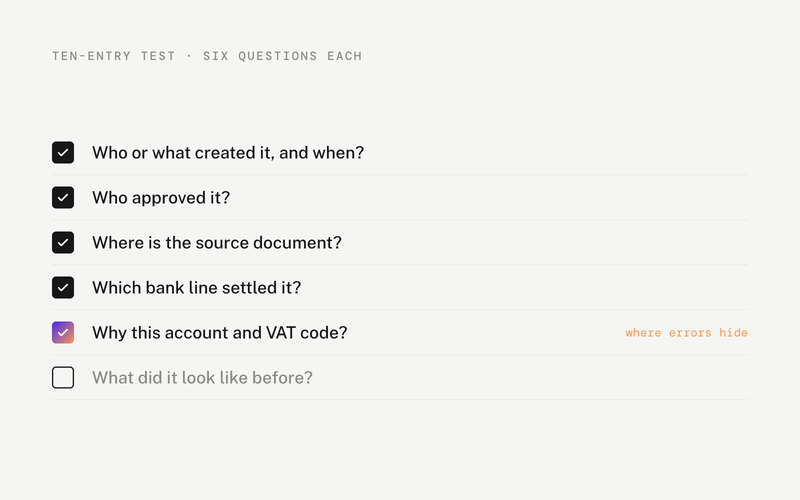
Ask the vendor to open any booking in the demo and show you:
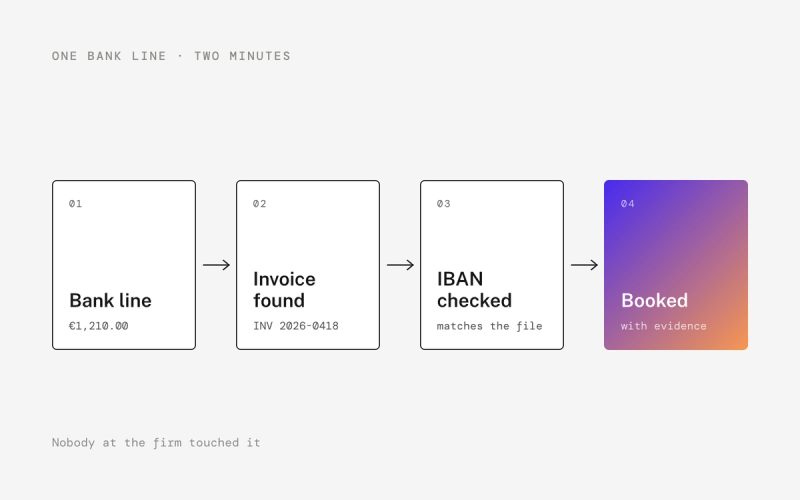
- The source document and the bank line it was matched to
- The rule or reasoning that produced the booking
- Whether an agent or a person booked it, and when
- Who approved it, if approval was required
- How to reverse it, and whether the reversal is recorded rather than deleted
If any of these takes more than a couple of clicks to find, it will take far longer when you actually need it.
How accurate is it on your own data?
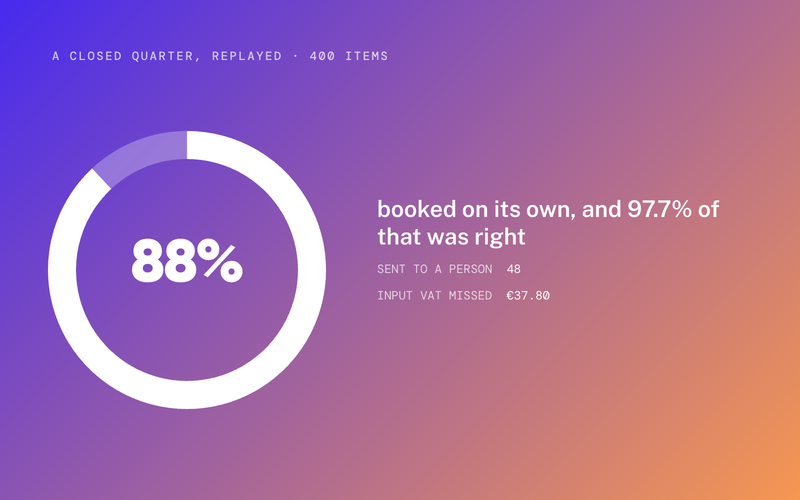
Vendor accuracy claims are measured on someone else's transactions. The only number that matters is how the tool performs on yours. Ask for a pilot on a recent month of real data, and score it yourself.
A simple scorecard sorts every transaction into four outcomes:
- Booked correctly without any change
- Sent to a person for review, rightly so
- Booked, but corrected by a person afterwards
- Booked wrong and not flagged
Here is an illustrative pilot on 400 transactions:
- 352 were booked correctly without change.
- 31 were sent for review and genuinely needed a person.
- 12 were booked but needed a correction.
- 5 were booked wrong and not flagged.
- That is 352 + 31 + 12 + 5 = 400.
The last group is the one to watch. A tool that asks too often costs you time. A tool that is confidently wrong costs you trust, and those 5 errors are the ones that surface at year-end. Ask the vendor how they reduce that group, and whether corrections you make become rules the tool follows next time.
Does it fit the ledger you already have?
Many small companies do not want to change accounting software, and many accounting firms cannot ask their clients to. Ask:
- Does it work on top of my current ledger such as Exact Online, Xero or Moneybird, through the ledger's official API?
- Is the sync two-way? Finished entries should be pushed back to your ledger, so your accountant keeps working where they always have.
- What happens if the sync fails? You want to know how errors are surfaced, not discover them at the next VAT return.
Thred Layer is built this way: agents work on top of the accounting software you already use and push finished entries back. If you would rather move to a ledger designed for agents, ask any vendor how migration works and how long they run in parallel with your current setup.
What happens when you leave?
Every contract ends eventually. Ask before you sign:
- Can I export all my data, including documents and the audit trail, in a usable format?
- How long is my data kept after the contract ends, and how is it deleted?
- Are there notice periods or minimum terms?
A vendor confident in its product makes leaving easy.
What else should you ask?
A few more questions that tend to separate serious vendors from the rest:
- Who do I talk to when something goes wrong, and how fast do they respond?
- How are incidents reported? You should be told about anything affecting your data without undue delay.
- What security certifications do you hold, or are working towards? Ask for the status honestly. "In progress" is a fine answer if it is true.
- How are you preparing for the EU AI Act? The obligations depend on how a system is used, so a vendor should be able to explain which apply to their product.
Red flags worth walking away from
- No data processing agreement, or one that arrives only after you push
- Vague answers about where data is processed or which model providers are used
- No way to see why an entry was booked
- A pilot that runs on the vendor's sample data instead of yours
- Write access required from the first day, with no option to start read-only
A good tool will welcome these questions, because the answers are what make it safe to rely on.
If you want to see how Thred answers every question on this list, read our security page, see how agents work on your current ledger on Thred Layer page, or book a demo.
Frequently asked questions
Is it safe to give AI software access to my accounting data?
It can be, if the vendor processes data in a jurisdiction you are comfortable with, signs a data processing agreement, does not train models on your data and restricts its own staff access. Start with read-only access and allow writing only after a pilot.
Do I need a data processing agreement with an AI accounting tool?
If the tool processes personal data on your behalf, the GDPR requires a written agreement with the processor. Accounting data almost always contains personal data, such as names of customers, suppliers and employees.
How do I test the accuracy of AI bookkeeping software?
Run a pilot on a recent month of your own transactions and sort every result into four groups: correct without change, rightly sent for review, corrected afterwards, and wrong without a flag. The last group matters most.
Does the EU AI Act apply to accounting software?
The AI Act sets obligations based on how an AI system is used and its risk level, and it applies in stages. Ask the vendor which obligations they believe apply to their product and how they meet them.
Should AI accounting software be allowed to pay bills?
It can prepare payment batches, but releasing payments should remain a human approval. Check that the tool cannot move money without a person confirming it.