How to trust software that books for you: audit trails, provenance and confidence
You can trust software with your bookkeeping when every entry can be traced, explained and corrected. Here is what that means in practice, and a ten-entry test you can run yourself.

Manoj Tutika5 min read

Working on this yourself? Talk to Mark, our co-founder. We’re here to solve it with you.
On this page
You can trust software that books for you when every entry it makes can be traced, explained and corrected. In practice that rests on three things: an audit trail that records who or what did each step, provenance that links every line to its evidence, and confidence that sends uncertain cases to a person instead of guessing.
If you own a growing business, you probably handed your books to a bookkeeper or an accounting firm years ago and trusted them because you knew them. Handing the same work to software feels different. This post explains what you should expect to see before you give that trust, and how to check it yourself in an afternoon.
Why is trusting software different from trusting a bookkeeper?
When a person books your invoices, you trust their training, their track record and the fact that you can call them. Most of what they know about your business lives in their head, and that is fine, because you can ask.
Software cannot earn trust that way, and it should not ask to. What it can do is something people rarely manage: keep a complete written record of every step, for every entry, for as long as you need it. That is a higher standard than most manual bookkeeping meets. The question is whether a given tool actually delivers it.
Your obligations do not change either way. In the Netherlands you have to keep your business records, including the general ledger and your purchase and sales records, for at least seven years, and the tax authority can ask how a figure came about. "The software did it" is not an answer. A record of what the software did, and why, is.
What should an audit trail record?
An audit trail is the history of each entry. For every step it should tell you what changed, when, who or what made the change, who approved it and what the entry looked like before.
Four properties separate a real trail from a log file nobody reads.
- It only grows. Mistakes are fixed by reversing and rebooking, not by editing in place or deleting. The wrong version stays visible next to the correction.
- It names the actor. A person, an agent or an integration such as a bank feed. "System" is not an actor.
- It records approval separately from creation. Who proposed an entry and who accepted it are two facts.
- It survives the sync. If entries are pushed into Exact Online or another package, you should be able to follow one entry across both.
What is provenance, and why is an attachment not enough?
The audit trail tells you what happened. Provenance tells you why the entry says what it says.
A PDF attached to a journal entry is a start. Full provenance connects each part of the booking to its own evidence.
- The amounts to the lines of the document.
- The payment to one specific bank line.
- The supplier to its record, and to how it was matched, for example by IBAN or VAT number.
- The account and VAT code to a reason, such as earlier bookings of the same supplier, a policy you set or an instruction you gave.
- The period to the invoice date or the service period.
Take a monthly hosting bill. Net €180.00, BTW 21% €37.80, total €217.80. With provenance, the entry can show that the amounts come from the invoice, that the payment is the direct debit of −€217.80 on 14 March, that it went to 4620 Hosting and software because the previous eleven bills from this supplier were booked there and approved, and that the 21% code applies because the invoice shows a Dutch VAT number and 21% BTW. 21% of €180.00 is €37.80, and €180.00 plus €37.80 is €217.80, so the numbers close.
A good test is whether someone new could rebuild the entry from the evidence alone, without asking anyone. Your accountant at year-end is exactly that someone.
What does confidence mean for software that books?
Confidence is the software's own estimate of how likely a booking is to be right, and more importantly, what it does with that estimate. A score on its own is useless to you. The behaviour around it is what counts.
- When the situation is familiar, the history is consistent and every check passes, it books.
- When something is new or conflicting, such as a first invoice from a supplier, an amount far off the usual pattern or two plausible accounts, it proposes and asks.
- When evidence is missing, such as a bank payment without an invoice, it does not book. It asks for the document.
You should be the one who decides where those lines sit, per type of work and per amount. A founder might let rent and software subscriptions book themselves while every new supplier above €1,000 comes to them first.
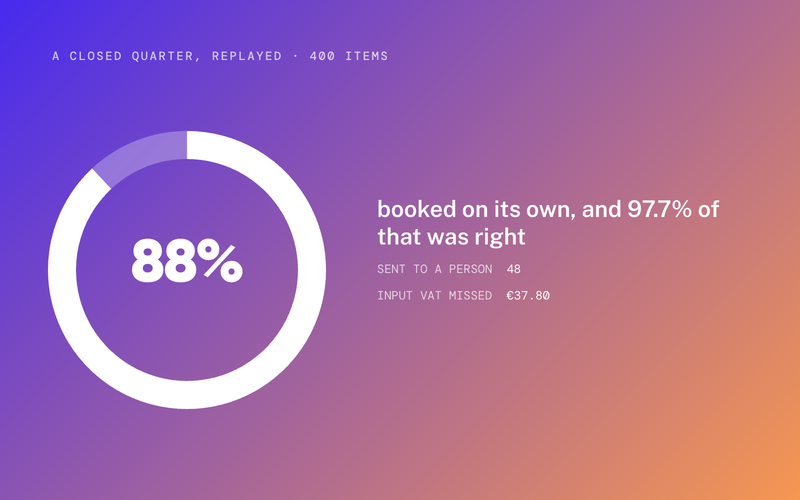
Two more things to look for. The question you get should be specific, for example "This €1,450 invoice from a new supplier is a laptop. Book it as an expense, or as equipment to depreciate?" rather than a vague warning. And confidence has to mean something. If a tool says it was sure about 95 out of 100 bookings, about 95 of those should survive your accountant's review. Ask how the vendor measures that, and sample it yourself during the first months.
A ten-entry test you can run this week
You do not need to understand the technology to judge it. Pick ten entries at random from last month, including a few that were booked automatically, and try to answer six questions for each within two minutes.
- Who or what created it, and when?
- Who approved it, if anyone did?
- Where is the source document, and do the amounts match it?
- Which bank line settled it?
- Why this account and this VAT code?
- If it was changed, what did it look like before?
If you can answer all six for nine out of ten entries, your bookkeeping is in good shape, whoever does it. If question five is mostly a shrug, that is where errors hide, and it is true for manual bookkeeping as much as for software.
What should you ask a vendor before you switch?
Keep it short and concrete.
- Can you show me the full history of one entry, including every step an agent took?
- Can entries be deleted, or only reversed?
- How do you decide when to ask me, and can I change those limits?
- How do you measure whether your bookings are right?
- Where is my data stored and processed, and is it ever used to train a model?
At Thred we answer those in writing on our security page. Agents read by default, write only with your permission and ask above the limits you set. Every step is traceable to the source document and the person who approved it, nothing is deleted from the record, and your data stays in the EU and never trains a model. Per agent, you choose between "Ask me first" and autonomous, and anything that needs you lands in one inbox.
Trust is not a setting you switch on. It is earned one entry at a time, and good software makes the evidence cheap for you to check.
If you want your books handled without giving up the ability to check every entry, see how Thred works for businesses or book a demo.
Frequently asked questions
What is an audit trail in accounting software?
It is the history of each entry: what changed, when, who or what made the change, who approved it and what it looked like before. A good trail only grows, so corrections are reversals rather than edits or deletions.
What does provenance mean for a journal entry?
Provenance links each part of a booking to its evidence. The amounts point to the document lines, the payment to a specific bank line, and the account and VAT code to a reason such as earlier bookings or a written policy.
What should accounting software do when it is unsure?
It should propose and ask a specific question instead of guessing, and it should not book at all when evidence such as an invoice is missing. You should be able to set the limits above which it asks, per type of work and per amount.
How long do Dutch businesses have to keep their records?
In the Netherlands the basic records, including the general ledger and purchase and sales records, must generally be kept for at least seven years, and some property-related data for ten. Check with your accountant for your situation.
How can I test whether my bookkeeping is traceable?
Pick ten random entries and try to answer who created and approved each, where the source document is, which bank line settled it, why it has its account and VAT code, and what it looked like before any change. Gaps show where errors can hide.
Sources
Read next
- AI bookkeeping for UK SMEs: what it does today, and what still needs a person
- How we measure bookkeeping without a human: the 99.5% method
- Connecting Claude or ChatGPT to your accounting system: what is safe
Where Thred comes in
Hosted in the EU, GDPR compliant, encrypted at rest and in transit. Thred reads by default and writes only with your permission.