
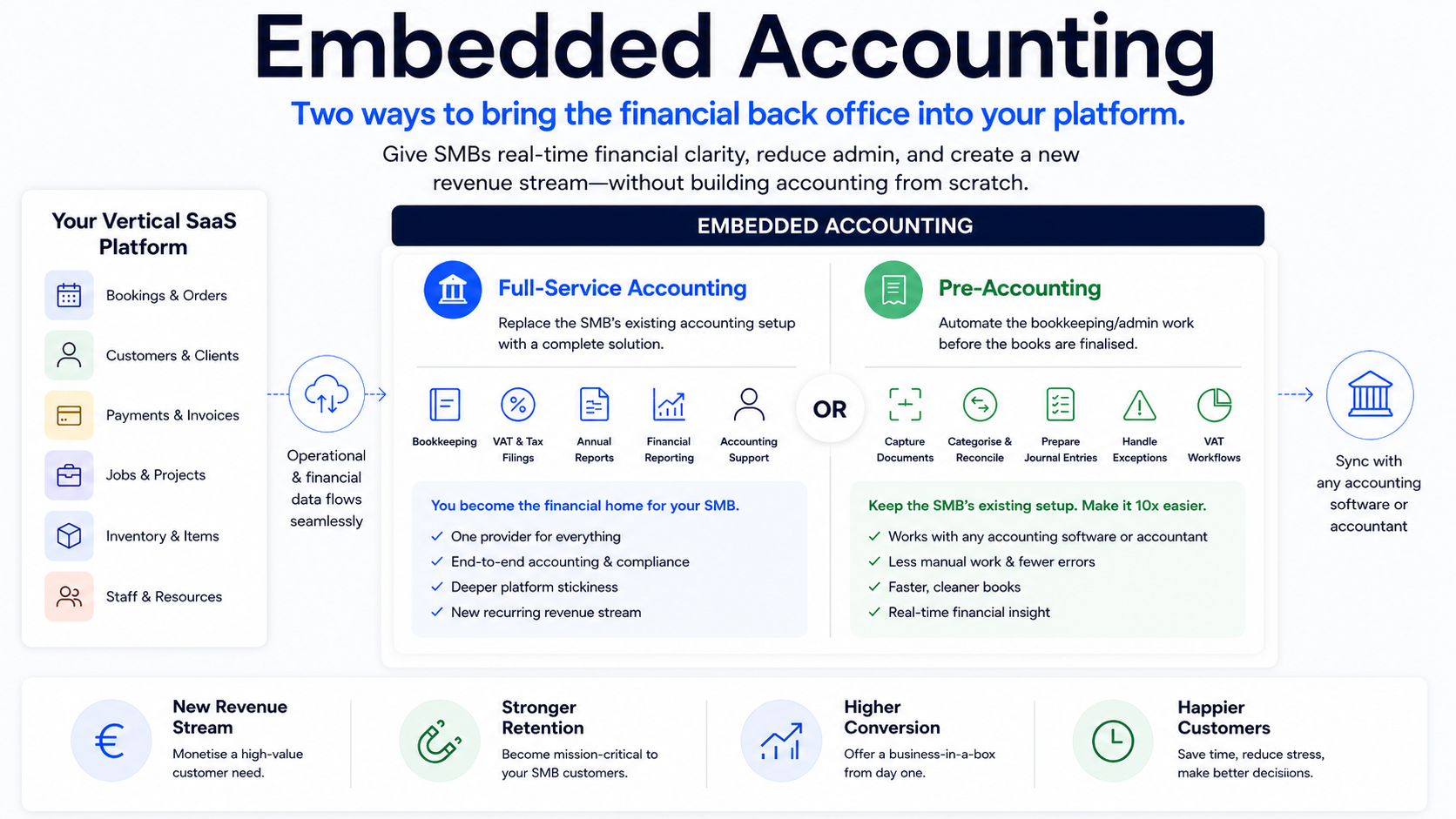
Most vertical SaaS platforms already run the front office for their small business customers.
They manage bookings, orders, jobs, payments, inventory, staff, clients, projects, memberships, or invoices. In many small businesses, the vertical SaaS platform is already the operating system for daily operations.
But accounting still sits somewhere else.
The business owner exports data from the platform, emails it to a bookkeeper, collects receipts and invoices from different inboxes and systems, waits for everything to be processed, and only then gets updated books.
That gap is the opportunity.
Embedded accounting allows vertical SaaS platforms to bring the financial back office into the product their customers already use every day.
For SME-focused platforms, this is not just a feature. It can become a new revenue stream, a retention driver, a conversion lever, and a way to help customers run better businesses.
What is embedded accounting?
Embedded accounting means offering accounting capabilities directly inside a vertical SaaS platform, SME bank, marketplace, or other product that already serves small businesses.
It does not always mean replacing the customer’s current accountant or accounting software.
There are two main models.
1. Embedded full-service accounting
Full-service accounting replaces the SME’s existing accounting setup.
Instead of using separate accounting software, a separate bookkeeper, and separate tax support, the SMB can get the full accounting service through the platform they already use to run their business.
This can include bookkeeping, VAT filings, annual reports, corporate income tax, reporting, and ongoing accounting support.
For a newly started business, this is powerful. The platform can offer a true business-in-a-box: the operational software plus the accounting service needed to stay compliant and understand the numbers.
2. Embedded pre-accounting
Pre-accounting is a more focused model.
It does not necessarily replace the SME’s accountant or accounting software. Instead, it automates the bookkeeping/admin work required to keep the books up to date.
That includes collecting relevant operational and financial data, capturing invoices and receipts, categorising transactions, reconciling activity, handling exceptions, preparing or suggesting journal entries, and supporting VAT workflows.
The output can then be pushed into the SMB’s preferred accounting software or shared with their accountant.
This matters because a lot of the pain in accounting is not the final filing. It is the messy work that happens before the books are complete.
The missing receipt.
The invoice sitting in Gmail.
The transaction with no context.
The exported spreadsheet.
The back-and-forth with the bookkeeper.
The monthly or quarterly delay before the owner sees accurate numbers.
Pre-accounting automates that layer.
The current SME workflow is still broken
Many SMEs still handle accounting admin manually.
They download data from their vertical SaaS platform. They email it to their bookkeeper. The bookkeeper uploads it into accounting software. Meanwhile, the business owner still needs to collect supplier invoices, receipts, card expenses, bank data, and other documents from different places.
This is slow, fragmented, and expensive.
It also means the books are often only accurate after month-end or quarter-end. Until then, the business owner is making decisions without a real-time view of cash flow, profitability, tax exposure, or financial performance.
That is a bad experience for the SME.
It is also a product opportunity for the vertical SaaS platform.
The platform already has much of the operational context. It knows the bookings, orders, jobs, customers, invoices, payments, subscriptions, projects, inventory, or staff activity. When that data is connected to financial documents and transactions, accounting becomes much easier to automate.
Why “just integrate with accounting software” is not enough
Many platforms start by thinking: “Can we just integrate with QuickBooks, Xero, Exact, Moneybird, Datev, Holded, or another accounting package?”
Sometimes that helps. But it is not enough.
A basic accounting integration usually only moves part of the data. It may push invoices, payments, or customer records into accounting software. But the SME still has to collect all the other documents and context needed to complete the books.
Receipts still need to be submitted.
Supplier bills still need to be captured.
Bank transactions still need to be matched.
Exceptions still need to be resolved.
Journal entries still need to be created or checked.
VAT still needs to be handled correctly.
In Europe, this is even more complex. Every country has its own accounting practices, tax rules, VAT requirements, and local software providers. Supporting accounting integrations across markets quickly becomes expensive and operationally heavy.
Unified accounting API providers can reduce integration complexity, but they are usually still a cost centre. They help move data into accounting systems. They do not automatically create a monetisable embedded accounting product for the vertical SaaS platform.
Embedded accounting is different.
It is not just an integration. It is a product and service layer that the platform can offer to its customers.
Why vertical SaaS platforms should care
There are three commercial reasons vertical SaaS platforms should take embedded accounting seriously.
1. It creates a new revenue stream
SMEs already pay for accounting software, bookkeeping, tax support, or manual admin help.
If the vertical SaaS platform can offer accounting or pre-accounting inside its own product, it can capture part of that spend.
This can be done as a full-service accounting offer, where the platform replaces the SME’s existing accounting setup. Or it can be done as a pre-accounting offer, where the platform automates bookkeeping admin while still working with the SMB’s existing accountant or accounting software.
Either way, the platform moves from being operational software to owning a bigger part of the SME’s financial workflow.
2. It increases retention
The more critical workflows a platform owns, the harder it becomes to leave.
If an SME uses a platform for bookings or jobs, switching may be inconvenient. If it also uses that platform to keep its financial admin under control, switching becomes much more painful.
Embedded accounting makes the vertical SaaS platform more deeply embedded in the business.
It turns the platform from a front-office tool into part of the company’s financial infrastructure.
3. It improves conversion
For new SMEs, embedded accounting makes the proposition much stronger.
Instead of selling only “software to manage your operations,” the platform can offer a more complete solution: run your front office, automate your back office, and get financial visibility from day one.
That is especially compelling for new businesses that do not yet have an accountant, accounting software, or mature admin processes.
They do not want more tools. They want fewer things to worry about.
Embedded accounting helps the platform sell simplicity.
The bigger opportunity: financial intelligence
The first benefit of embedded accounting is automation.
Less admin.
Fewer exports.
Fewer emails.
Fewer missing documents.
Fewer manual handoffs.
Faster books.
But the bigger opportunity is intelligence.
Once operational and financial data are available in real time, the platform can help the SME answer better questions:
Which services are most profitable?
Why is cash flow tight this month?
Which jobs or customers have the best margins?
Am I setting enough aside for VAT?
Where am I overspending?
What should I change to improve profitability?
This is where vertical SaaS platforms have a structural advantage over generic accounting tools.
A restaurant platform understands menus, orders, shifts, tips, delivery channels, and inventory.
A field services platform understands jobs, technicians, materials, travel time, and recurring contracts.
A salon or spa platform understands bookings, treatments, staff utilisation, products, and repeat visits.
A fitness platform understands memberships, classes, churn, attendance, and subscriptions.
Generic accounting software sees financial records.
Vertical SaaS platforms understand the business behind those records.
That is why embedded accounting can become much more than bookkeeping automation. It can become the intelligence layer for the SME.
Which verticals are best suited?
Embedded accounting is especially relevant for SME verticals with high transaction volume, recurring document flows, fragmented systems, or meaningful operational complexity.
Strong examples include:
- field services
- restaurants
- fitness and wellness
- medical
- pet care
- retail
- salons and spas
- janitorial services
- e-commerce and webshops
- travel
- automotive
- construction
These businesses often have many payments, receipts, supplier bills, invoices, staff costs, bank transactions, tax obligations, and operational systems.
They are big enough to feel the pain, but often too small to have a sophisticated finance function.
That is the sweet spot.
Why platforms should not build this themselves
Some vertical SaaS companies may consider building embedded accounting internally.
For most, that is not the best starting point.
Accounting infrastructure is specialised. It requires document capture, data ingestion, reconciliation logic, categorisation, journal entry creation, VAT workflows, exception handling, reporting, accounting integrations, permissions, auditability, and local compliance knowledge.
In Europe, this becomes even harder because accounting and tax requirements differ by country.
For most vertical SaaS platforms, accounting is not the core competence. Serving a specific industry is.
Embedding accounting infrastructure lets the platform launch a valuable new product layer without turning its product and engineering teams into an accounting infrastructure company.
That matters because speed matters.
A platform can start with pre-accounting, automate the painful bookkeeping admin, and keep the customer’s existing accounting setup in place. Or it can offer full-service accounting for SMEs that want one provider to handle everything.
The right model depends on the customer segment, market, and product strategy.
But the strategic direction is the same: accounting moves closer to the platform where the SMB already runs the business.
Embedded accounting is the next vertical SaaS layer
Vertical SaaS platforms won by understanding industry-specific workflows better than horizontal tools.
The next opportunity is to connect those workflows to the financial back office.
Embedded accounting allows platforms to help SMEs save time, reduce manual admin, stay compliant, understand their numbers, and make better decisions.
For the platform, it creates revenue, retention, conversion, and differentiation.
That is why SMB-focused vertical SaaS platforms should care.
Not because every platform should become an accounting firm.
But because every platform should ask:
If we already help customers run the business, why are we sending the financial back office somewhere else?
Want to explore embedded accounting?
Thred helps SME-focused vertical SaaS platforms and SME banks embed accounting into their own products.
Platforms can offer full-service accounting that replaces the SME’s existing accounting setup, or pre-accounting that automates bookkeeping admin while working with the SMB’s preferred accounting software or accountant.
If you want to learn how Thred can help your platform launch embedded accounting, you can schedule a call here: https://thredfi.com/contact-us