Monthly investor reporting from the finance side: a reliable update from live books
A monthly investor update is only as good as the close behind it. How finance leads produce one from live books, with agents drafting the numbers and you writing the story.

Mark Holleman5 min read

Working on this yourself? Talk to Mark, our co-founder. We’re here to solve it with you.
On this page
A reliable monthly investor update is a short report built from closed books, with the same metrics, the same definitions and the same send date every month. The finance work is in the close and the definitions; once those are in place, agents can draft the numbers and the variance notes, and you review them and write the story.
If you run finance in a venture-backed company, you probably know the other version. On the fifth working day the founder asks for "the numbers for the update". You export the ledger, paste it into last month's spreadsheet, fix the formulas that broke, and send something that is mostly right. Two months later someone notices that burn was calculated differently in July.
Investors forgive a bad month. They are far less forgiving of numbers that move after they were sent.
What should a monthly investor update contain?
Keep it to what the people around the table actually use to judge the business. For most growing companies that is:
- cash at month-end, and the change in the month
- net burn, and runway at the current burn rate
- revenue for the month, and recurring revenue if you have it
- gross margin
- headcount, actual against plan
- two to four operating KPIs specific to your model
- actuals against budget for the month and year to date
- a short commentary, and any asks
Everything on that list except the commentary and the asks comes from the ledger, the bank and a handful of systems around them. That is the part finance should own and automate.
Why do the numbers drift from month to month?
Drift rarely comes from bad arithmetic. It usually comes from three habits.
The definitions live in someone's head
Is net burn the change in cash, or operating cash outflow? Does it include a loan drawdown? Is recurring revenue based on invoices, contracts or recognised revenue? If the answer depends on who built the spreadsheet that month, the trend line means nothing.
The update is built before the books are closed
Bank lines are booked, but supplier invoices for the month are still arriving and the payroll journal is a day late. The update goes out on estimates, and the closed numbers a week later are different.
The spreadsheet is a second ledger
Each month someone re-keys or re-maps ledger data into a reporting file. Every manual step is a place for a mapping to change without anyone noticing.
How do you define your metrics once?
Write one page that defines every number in the update, and do not change it without saying so. For each metric, note the formula, the ledger accounts or systems it comes from, and how you treat edge cases.
There is a useful parallel in IFRS 18, which applies to companies reporting under IFRS from 2027. It requires management-defined performance measures used in public communications to be disclosed and reconciled to IFRS subtotals. A private investor update is not in scope, but the discipline is worth copying: if you show a number that is not in the financial statements, you should be able to say exactly how it ties back to them.
A worked example: net burn and runway
Here is how a clear definition stops the most common argument. Say your company closed September with these figures:
- cash on 31 August was EUR 2,400,000
- cash on 30 September was EUR 2,280,000
- in September you drew down EUR 100,000 of a venture debt facility
The change in cash is EUR 2,280,000 - EUR 2,400,000 = minus EUR 120,000. That number flatters the month, because EUR 100,000 of it is borrowed money. Net burn, defined as the change in cash excluding financing flows, is EUR 120,000 + EUR 100,000 = EUR 220,000.
For runway, use an average so one lumpy month does not swing it. If net burn was EUR 200,000 in July, EUR 210,000 in August and EUR 220,000 in September, the three-month average is EUR 630,000 / 3 = EUR 210,000. Runway is EUR 2,280,000 / EUR 210,000 = 10.9 months.
Write those two definitions down, show the drawdown as a separate line, and the question "why does burn look lower this month?" never comes up again. Whether runway should also account for scheduled loan repayments is a choice; make it once and state it.
What does a reporting month look like with agents?
The goal is a fixed rhythm where the books close first and the update follows from them.
During the month
The real shift is that bookkeeping happens as transactions arrive instead of at month-end. Bank and payment provider lines are matched to invoices as they come in, supplier invoices are captured and coded, and missing documents are requested while people still remember them. By the last day of the month, most of the work is already done.
Working days one to three: close
What is left is period-end work: accruals for invoices not yet received, prepayments, deferred revenue, depreciation and payroll. An agent prepares these entries from your rules and last month's pattern, and you approve them. Balance sheet reconciliations run automatically, so you look only at accounts that do not tie.
Working day four: draft
From the closed ledger, an agent fills the update template: every metric calculated by your written definitions, compared with last month and with budget, and a first draft of variance notes ("software costs EUR 6,400 above budget, driven by two annual renewals paid in September"). Each number links to the entries behind it.
Working day four or five: review and send
You check the numbers that moved most, rewrite the commentary in your own words, add the asks, and send. Then you lock the period.
In Thred, this runs on agents on top of the ledger you already use, or on Thred's own continuously updated ledger. Chat builds the reports and dashboards from live numbers, and the monthly board pack comes from the same books as the update, so the two never disagree.
What should the agent write, and what should you write?
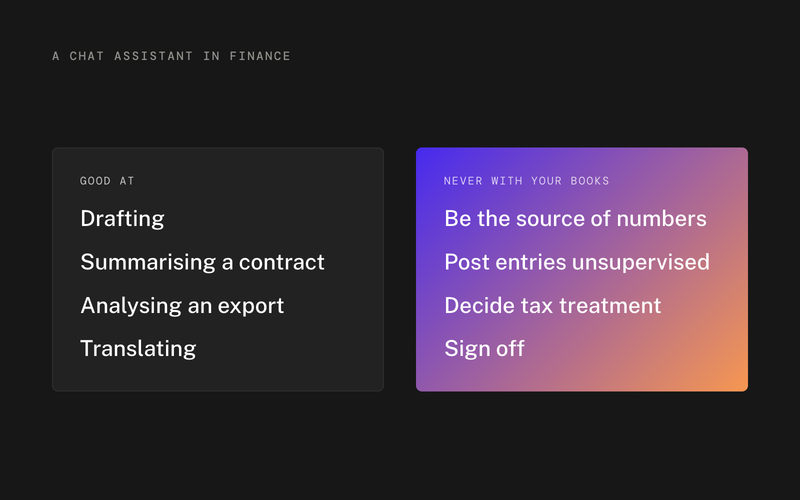
Let the agent do what it can prove. Every figure, every comparison and every factual variance note should be calculated from the ledger and traceable to source. If a number cannot be traced, it should not be in the draft.
Keep the judgement for yourself:
- the narrative of the month, and what it means for the plan
- forecasts and anything forward-looking
- how you explain a miss, and what you are doing about it
- the asks, and who they go to
A draft that is correct and dull is a perfect starting point. Your job is to make it honest and useful.
What happens when you have to restate a number?
Sometimes a late invoice or a correction changes a month you already reported. Do not quietly overwrite it. Show the restated figure next to the original in the next update, with one line explaining why. Investors who see corrections handled openly trust the rest of the numbers more, not less.
The best protection is a short close on books that are current every day, so restatements become rare. That is what Thred for businesses is built for: books that are correct as transactions happen, and reporting that follows from them without a spreadsheet in between.
If your next investor update is still built by hand, book a demo and see it drafted from your own ledger.
Frequently asked questions
What is the difference between change in cash and net burn?
Change in cash includes every inflow, including loans and equity raised. Net burn usually excludes financing flows, so it shows what the business itself consumed. Pick one definition, write it down and use it every month.
How is runway calculated?
Runway is cash at month-end divided by monthly net burn. Many finance teams use an average of the last three months of burn so one unusual month does not distort it. State whether scheduled loan repayments are included.
When should a monthly investor update be sent?
Pick a fixed working day after the close, for example the fifth working day, and keep to it. Sending before the books are closed tends to produce numbers that change later.
What should I do if a number I already reported changes?
Show the restated figure next to the original in the next update with a short explanation. Quietly overwriting reported numbers damages trust more than the correction itself.
Can AI write the investor update for me?
Software can calculate the metrics, compare them to prior months and budget, and draft factual variance notes from the ledger. The interpretation, forecasts and asks should come from the finance lead or founder.
Sources
Read next
- Is your company ready for AI in its books? A readiness check for founders and finance leads
- What AI tools really cost a finance team, and how to justify the spend
- Can an Agentic Finance Platform Replace Your Bookkeeper and Accounting Software?
Where Thred comes in
For finance leaders who want more capacity without more headcount.