Determining VAT treatment in software: codes, place of supply and where a model must not decide alone
A VAT code is a decision, not a label. How software should establish the facts, apply place-of-supply and reverse-charge rules, and know when to stop and ask.

Manoj Tutika7 min read

Working on this yourself? Talk to Mark, our co-founder. We’re here to solve it with you.
On this page
Determining VAT treatment means deciding, for every invoice line, where the supply is taxed, at what rate, who accounts for the VAT and which box of the return it lands in. Good software splits that decision in two: it establishes the facts with evidence, then applies written rules to those facts. A language model can help with the first part. It should not own the second.
This post is for controllers, finance leads and tax advisors who are asked to trust software with VAT. It explains how the decision should be built, what you should be able to see afterwards, and where a person still has to sign off.
What is a VAT code, really?
In most ledgers a VAT code looks like a short label on a line: "21% high", "Reverse charge EU", "0% ICP". In practice it bundles several separate decisions into one value:
- The rate, such as 21% or 9% in the Netherlands, or 20% in the UK
- Who owes the VAT, the supplier or the customer under the reverse charge
- The return box the base amount and the VAT go to
- Deductibility, whether the VAT can be reclaimed as input tax
- Reporting duties, such as the ICP declaration (the Dutch EU sales listing) for supplies to EU businesses
When a bookkeeper picks a code from a dropdown, all five decisions are made at once, from memory. The code is visible later, but the reasoning is not. Software should store the reasoning too: which facts were established, which rule was applied and what evidence supports each fact.
How does software decide where a supply is taxed?
Place of supply is the question that drives everything else. Within the EU it is set by the VAT Directive (2006/112/EC), and the core rules are short:
- Services to businesses (B2B). Article 44 taxes the service where the customer is established. If the supplier is in another country, Article 196 makes the customer liable for the VAT. That is the reverse charge.
- Services to consumers (B2C). Article 45 taxes the service where the supplier is established, with important exceptions, for example for electronically supplied services to consumers in other EU countries.
- Goods to businesses in another EU country. Article 138 exempts the supply in the country of dispatch when the goods leave that country and the customer has a valid VAT number in another member state. The supplier also has to report the supply in its EU sales listing.
There are many exceptions to the general rules: services connected with immovable property, passenger transport, admission to events, restaurant services, and more. A system that only knows Articles 44 and 45 will be right most of the time and confidently wrong in the cases that matter.
The UK has applied its own rules since it left the EU VAT system on 1 January 2021, but the logic is similar. HMRC's Notice 741A sets out the general B2B rule (taxed where the customer belongs) and the reverse charge for services bought from overseas suppliers.
The important design choice is the order. Facts come first: what was supplied, to whom, and where each party is established. Only then does the rule run, and the rule is logic a tax advisor can read and test, not a prompt.
A worked example: one Dutch quarter
Take a Dutch BV with four kinds of transactions in a quarter. All amounts are illustrative.
- Domestic sales of €20,000 at 21%. VAT €4,200. Box 1a.
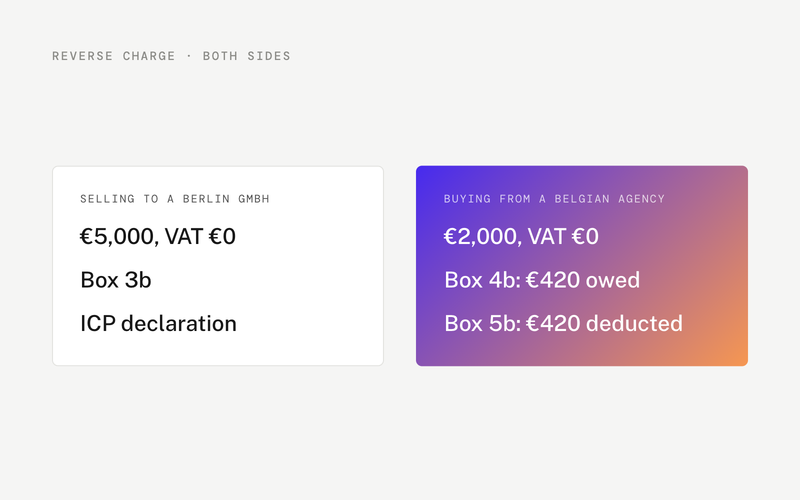
- Consulting for a German GmbH of €8,000. The customer is a business established in Germany, so under Article 44 the service is taxed there and the German customer reverse-charges the VAT. The BV invoices without VAT, states that VAT is reverse-charged, reports €8,000 in box 3b and includes the customer in its ICP declaration.
- A software subscription from an Irish supplier of €1,000, invoiced without VAT. The BV is the business customer, so it accounts for the Dutch VAT itself: €1,000 in box 4b with €210 VAT, which it can usually deduct as input tax in the same return.
- Domestic purchases of €3,000 with €630 VAT.
The return then comes out as:
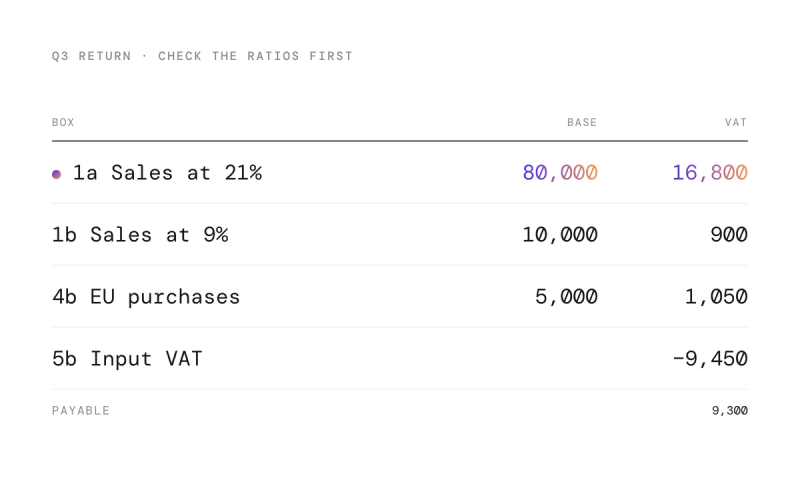
- VAT due (box 5a) of €4,200 + €210 = €4,410
- Input tax (box 5b) of €630 + €210 = €840
- Payable of €4,410 − €840 = €3,570
The reverse charge on the Irish subscription is cash-neutral for a fully taxable business, which is exactly why it gets skipped. Leaving it out does not change the amount payable, but box 4b is then wrong, the return no longer matches what the Irish supplier reports in its EU sales listing, and the omission is the kind of thing an audit finds. If your business has exempt activities and cannot deduct all input tax, it is no longer neutral at all. Check the specifics with your accountant.
The same purchase seen from the UK works the same way. A UK company buying that subscription accounts for the reverse charge by putting the output tax in box 1, the input tax in box 4, and the full value in boxes 6 and 7 of its VAT return, as HMRC's Notice 741A describes.
What should the determination record look like?
If software sets VAT codes, every line should carry a record of how the code was reached. You should be able to open one and answer "why is this in box 4b?" without asking anyone.
The record has three layers, and each one has a different owner:
- Facts, with evidence. Supplier country and VAT number from the invoice, the nature of the supply, the customer's status. Each fact points to where it came from, such as a field on the PDF or a check against the VIES database the European Commission runs for EU VAT numbers.
- Rule, with a reference. The rule identifier and the legal basis, for example Article 44 with Article 196 for a B2B service from another EU country, mapped to the Dutch reverse-charge code.
- Outcome, with an approver. The code, the boxes, and who or what confirmed it. A repeat of a known pattern can be confirmed by the rule itself. A new pattern needs a person.
Where must a language model not decide alone?
Language models are useful in VAT work if each part of the job goes to the right tool. We think about it in three groups.
What a model does well:
- Reading invoices in any layout and language, and pulling out the supplier, VAT number, line descriptions and any text such as "reverse charge" or "autoliquidation"
- Classifying what was supplied, such as a software licence, a consulting day or a physical product, from a free-text description
- Spotting inconsistencies a person would miss in volume, such as a zero-VAT invoice from a Dutch supplier or a VAT amount that does not match the rate
What should be deterministic code:
- Applying place-of-supply rules once the facts are known
- Rate tables, return-box mapping and every calculation
- VAT number validation against VIES, with the result stored as evidence
- Tracking thresholds, such as the €10,000 EU-wide threshold for cross-border sales to consumers, above which you generally charge the customer's country's VAT and can report it through the One Stop Shop (OSS)
What needs a person, usually your accountant or tax advisor:
- Fact patterns the system has not seen before
- Exemptions, such as financial, medical or education services, and partial deduction of input tax
- Supplies connected with property, events or transport, and other exceptions to the general rules
- Questions about fixed establishments, mixed supplies and anything that changes how the business is set up, such as registering for OSS
The line runs through the middle of the work. A model can tell you that an invoice is for a cloud software subscription from an Irish company with an Irish VAT number. It should not then decide by itself that the reverse charge applies, because that is a rule, and rules should be written down, tested and versioned. When a model says "I think this is a reverse-charge purchase", the system should ask which facts that rests on and run the rule itself.
Which controls catch VAT errors before the return?
Even with a clean design, you want checks that run on every line, not only at quarter-end. Useful ones include:
- An invoice from an EU supplier without VAT and without a reverse-charge statement is flagged, not booked
- Every reverse-charge purchase posts both sides, the VAT due and the input tax, so it can never be half-booked
- The box 3b total equals the ICP declaration total, customer by customer
- A customer VAT number is checked against VIES before the invoice is sent, and the check is stored with the invoice
- A domestic line can only carry a rate that exists for that country and date
- When a rule changes, earlier determinations can be re-run and the differences listed
These are invariants (conditions that must always hold). They let your accountant review exceptions instead of re-checking every line.
How does Thred approach this?
In Thred's ledger, VAT is part of booking. Each transaction is booked as it happens, under your rules and the local accounting standards, and every entry is traceable back to its source document. The VAT position is therefore current at any moment, and VAT returns are prepared from it and reviewed by a registered accountant, yours or one of ours.
Your rules and history live with the ledger, so a repeat pattern, like the same Irish subscription every month, is booked the same way every time, while a new one is surfaced as an exception for a person to decide. If you keep your current accounting software, the same approach works through Thred Layer, with the finished entries written back to your ledger. For firms handling VAT across many clients, the accounting firms page shows how review fits a portfolio.
Rules change, so whatever software you use, treat this post as a design guide rather than tax advice and check specific cases with your accountant or tax advisor.
If you want to see VAT determinations with their evidence on your own transactions, book a demo.
Frequently asked questions
What decides where a service is taxed for VAT in the EU?
For services between businesses, Article 44 of the EU VAT Directive taxes the service where the customer is established. For services to consumers, Article 45 generally taxes them where the supplier is established. Both general rules have exceptions, for example for services connected with property or admission to events.
When does the reverse charge apply to a purchase from another EU country?
When a business buys a service that falls under the B2B general rule from a supplier established in another EU country, the customer accounts for the VAT itself. In the Netherlands the base and VAT go in box 4b, and the VAT is usually deductible as input tax in the same return.
Can a language model choose VAT codes on its own?
A model is good at reading invoices and classifying what was supplied, but applying the place-of-supply rules should be written, tested logic. Exemptions, property-related services and fact patterns the system has not seen before should go to an accountant or tax advisor.
How does a UK business account for the reverse charge on services from abroad?
According to HMRC Notice 741A, the business includes the output tax in box 1 and the input tax in box 4 of its VAT return, and the full value of the supply in boxes 6 and 7.
What is the €10,000 OSS threshold?
It is the EU-wide annual threshold for cross-border distance sales of goods and certain services to consumers in other EU countries. Above it, the supplier generally charges the VAT of the customer's country and can report it through the One Stop Shop instead of registering in each country.
What should a VAT audit trail show for each invoice line?
It should show the facts used, where each fact came from, the rule and its legal basis, the resulting code and return boxes, and who or what confirmed the outcome. That lets an accountant answer why an amount is in a box without reconstructing it.
Sources
Read next
- OSS VAT for EU e-commerce: when it applies, the €10,000 threshold, and how to book it
- Duplicates, retries and idempotency: keeping the ledger right when data arrives twice
- Dutch VAT return deadlines 2026 and 2027: every date by month, quarter and year
Where Thred comes in
Thred’s own general ledger, built for agents. Every transaction is booked as it happens, under your rules, and traceable back to its source.